To remove smoke and soot damage correctly, you need to dry-sponge and HEPA-vacuum surfaces before any liquid touches them, match the cleaning method to the type of soot (dry, wet, protein, or fuel/oil), neutralize embedded odor at the molecular level, and seal porous materials that cannot be fully cleaned. DIY cleaning often makes the damage worse because the most common household instinct after a fire—wiping soot with a wet rag or spraying an all-purpose cleaner—drives greasy, acidic residue deeper into drywall, grout, and wood, smears it across clean surfaces, and "sets" stains permanently. What started as a surface film becomes a chemical etching problem that costs far more to undo than the original cleanup.
At AZA Restoration, our crews respond to fire and smoke calls across Northern Virginia every week, and the homes where someone "already tried to clean it up" are almost always the harder, more expensive jobs. This guide explains exactly why that happens, what a professional process looks like, and how homeowners in Fairfax, Loudoun, Prince William, Stafford, Fauquier, and Arlington counties can protect their property and their insurance claim before the damage becomes permanent.
Why does soot behave differently than ordinary dirt?
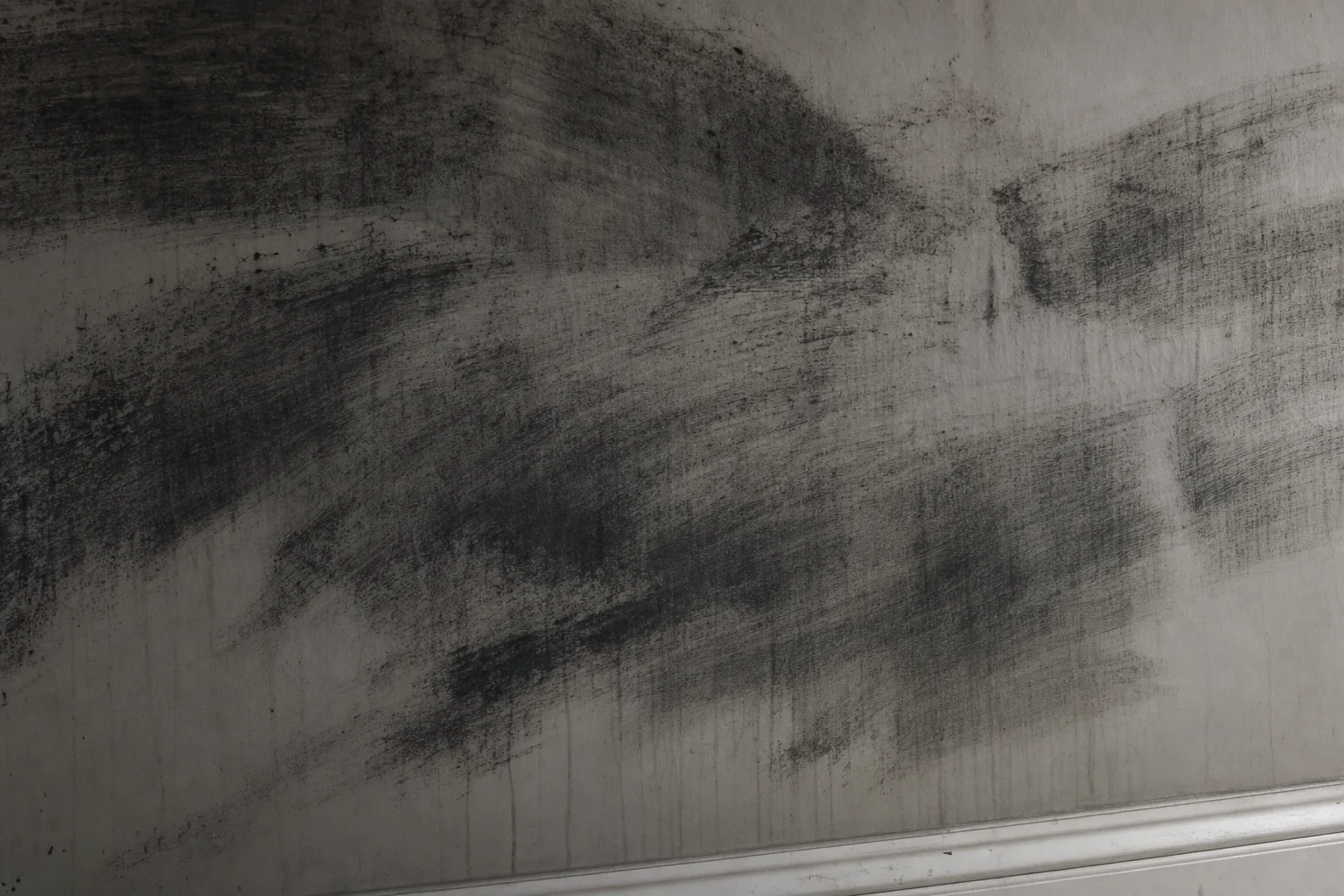
Soot is not dust. It is a residue of incomplete combustion—microscopic carbon particles bound up with oils, acids, and whatever synthetic materials burned in the fire. That chemistry is the entire reason DIY cleaning backfires. Ordinary household dirt sits on a surface and lifts off with water and detergent. Soot is engineered by heat to bond into surfaces, and it carries an acidic, often oily charge that keeps reacting with materials long after the flames are out.
Three properties make soot uniquely destructive:
- It is acidic. Smoke residue lowers the pH at the surface of metals, grout, stone, and finishes. Within hours it begins etching glass, pitting chrome and brass, yellowing appliances, and discoloring grout. The longer it sits, the more permanent the staining.
- It is electrostatically charged and incredibly fine. Soot particles are often smaller than one micron. They infiltrate wall cavities, HVAC ductwork, electronics, the backs of cabinets, and the inside of light fixtures—places a homeowner never thinks to clean and a wet rag will never reach.
- It is frequently oily. When plastics, foam, and kitchen grease burn, the resulting residue is a sticky, smeary film. Hit that with water and you emulsify it into a paste that spreads across everything you touch.
Understanding this chemistry is the foundation of every decision a trained restoration specialist makes. The wrong move on the wrong type of soot turns a recoverable surface into one that has to be replaced.
The four types of soot—and why each needs a different approach
Professionals classify smoke residue before choosing a single cleaning tool. Using the wrong method is the single most common DIY mistake.
| Soot type | Typical source | Behavior | Why DIY fails |
|---|---|---|---|
| Dry soot | Fast, high-temperature fires (paper, wood) | Powdery, brittle, sits loosely on surfaces | Wiping or wetting smears it into a stain that was easily vacuumed away |
| Wet soot | Low-temperature, smoldering fires (plastics, rubber) | Thick, sticky, smeary, strong odor | Water turns it into a paste; rubbing grinds it into pores |
| Protein residue | Kitchen/cooking fires | Nearly invisible, varnish-like film with intense, lingering odor | Homeowners miss it entirely or "clean" only what they can see while odor saturates the home |
| Fuel/oil soot | Furnace puff-backs, oil burners | Dense, greasy, far-reaching | Standard cleaners cannot break the oil bond; spreads across HVAC system |
Notice the pattern: every soot type fails differently, but they nearly all fail when introduced to water or pressure too early. That is why the professional sequence always starts dry.
How to remove smoke and soot damage the right way: the professional sequence
The single most important rule of soot removal is dry before wet. Trained crews never introduce moisture until every loose particle has been mechanically lifted off the surface. Here is the order a professional follows, and it is deliberately the opposite of most homeowners' instincts.
- Assess and ventilate. Identify the soot type, test surfaces in inconspicuous spots, and establish controlled airflow so that disturbed particles are captured rather than redistributed throughout the home.
- Protect and contain. Seal off unaffected rooms with plastic sheeting and use negative air pressure with HEPA-filtered air scrubbers so soot does not migrate while you work.
- Dry-clean first. Use chemical dry sponges (vulcanized rubber sponges) and HEPA vacuums to lift loose soot without smearing. This step alone removes the majority of dry residue and prevents the staining that DIY cleaning causes.
- Wet-clean strategically. Only after dry removal do crews apply cleaning agents—and the agent is matched to the soot type and the surface, working top to bottom so that drips fall onto still-dirty areas, not cleaned ones.
- Address hidden contamination. Clean wall cavities, ductwork, the tops of doors and trim, light fixtures, and the backs of cabinets—the places fine particles settle that homeowners never reach.
- Deodorize at the source. Neutralize odor molecules with thermal fogging, hydroxyl or ozone treatment, and air scrubbing—not by masking with air fresheners that wear off in days.
- Seal and reconstruct. Encapsulate any porous surface that retains odor or staining, then repaint, refinish, or rebuild as needed.
This sequence is why professional smoke damage restoration consistently produces results a homeowner cannot replicate with a sponge and a bottle of cleaner. The equipment, the chemistry, and the order of operations are all engineered around soot's behavior.
The DIY mistakes that turn a $3,000 cleanup into a $30,000 rebuild
Most of the damage we see added by well-meaning homeowners traces back to a short list of predictable errors:
- Wiping soot with a wet cloth. The most damaging move of all. Water emulsifies oily soot and pushes it into porous drywall, grout, and unfinished wood, setting stains that no longer come out.
- Using regular household or all-purpose cleaners. These are formulated for everyday dirt, not acidic carbon residue. They smear soot and can react with it, leaving permanent discoloration.
- Vacuuming with a standard shop vac. A non-HEPA vacuum blows sub-micron soot straight through the filter and back into the air, spreading contamination to every room.
- Ignoring the HVAC system. Running the air handler after a fire pulls soot through the ducts and redeposits it throughout the house, recontaminating rooms that were never touched by the fire.
- Painting over soot. Paint does not neutralize odor or acid. The smell bleeds back through within weeks, and the residue keeps working on the surface underneath.
- Masking odor instead of removing it. Candles, sprays, and plug-ins cover protein and smoke odor temporarily. The moment humidity rises—common in the Northern Virginia summer—the smell returns full force.
Each of these mistakes does the same thing: it converts a surface-level problem that responds to dry cleaning into an embedded, chemical, structural problem that requires replacement and reconstruction.
Smoke or soot damage in your home or business? Do not wipe, spray, or run the HVAC—every hour of delay lets acidic residue set deeper. Call AZA Restoration now at (571) 506-6668. We guarantee a 90-minute on-site arrival across Northern Virginia, document everything for your claim, and bill your insurance directly. One call rebuilds it all.
What does professional smoke and soot removal cost in Northern Virginia?
Soot and smoke cleanup typically ranges from about $2,000 to $15,000 depending on the size of the affected area, the soot type, and how far the residue and odor have spread. Where there has been actual fire damage and structural loss, total restoration including reconstruction can run from a few thousand dollars for localized soot cleanup up to $50,000 or more for a full rebuild. The single biggest variable in that range is often time—and whether anyone attempted DIY cleaning first.
| Scope of work | Typical market range | Typical timeline |
|---|---|---|
| Soot/smoke surface cleanup & odor removal | $2,000 – $15,000 | Days |
| Fire damage: soot/smoke cleanup starting point | From ~$3,000 | Days |
| Full fire reconstruction | Up to $50,000+ | Weeks |
| Single-room rebuild | From ~$10,000 | Weeks |
| Major reconstruction | $100,000+ | Weeks to months |
These are typical market ranges, not quotes—every property is different. What is consistent is the relationship between delay and cost. Soot that is dry-cleaned within the first day or two is usually a cleanup job. Soot that has been wiped wet, painted over, or left to etch for a week becomes a refinishing and replacement job. The math almost always favors calling a professional immediately. Our fire damage restoration teams provide written, itemized estimates and coordinate the entire scope—cleanup, deodorization, and reconstruction—under one roof.
Smoke and soot removal: repair vs. replace
One of the most valuable things a trained restoration specialist does is decide, surface by surface, what can be restored and what must be replaced. Restoring is almost always cheaper and faster than replacing, but only if the material has not been pushed past the point of recovery—which is exactly what aggressive DIY cleaning does.
| Material / item | Usually restorable | Usually replaced |
|---|---|---|
| Hard surfaces (sealed wood, tile, glass, metal) | Yes—if cleaned before acid etches | If pitted, etched, or stained through |
| Drywall | Light surface soot, after sealing/repainting | Saturated, smeared, or odor-retaining drywall |
| Carpet & padding | Light dry soot on durable carpet | Padding and heavily contaminated carpet |
| Upholstery, clothing, contents | Yes, via specialized off-site cleaning | Items with melted or fused damage |
| Insulation | Rarely | Almost always, once soot penetrates |
| HVAC ductwork | Professional duct cleaning | If interior lining is contaminated |
For belongings, the repair-vs-replace decision is where a structured pack-out and contents cleaning service earns its keep. Crews inventory, photograph, and remove salvageable items to a controlled facility where ultrasonic cleaning, ozone chambers, and specialized textile processes can restore things that would be destroyed by household cleaning—electronics, artwork, documents, clothing, and furniture. Done well, pack-out both lowers the claim and saves irreplaceable possessions.
Why the Northern Virginia climate makes fast soot removal even more urgent
Geography and climate are not abstract concerns here—they directly affect how quickly smoke damage becomes permanent. Northern Virginia sits in a humid, mid-Atlantic climate, and that humidity is soot's best friend.
Moisture in the air keeps acidic residue chemically active. In a dry climate, soot etching slows; in the humid summers of Fairfax, Loudoun, Prince William, Stafford, Fauquier, and Arlington, surface corrosion and staining continue around the clock. Humidity also reactivates absorbed odor molecules, which is why a home that smelled "okay" in a dry week reeks of smoke again after a humid stretch—and why DIY odor masking always fails locally.
The region's mix of older homes near the Potomac and Occoquan watersheds and newer construction across the suburbs adds another wrinkle. Many area homes combine porous original materials—plaster, hardwood, masonry—with modern synthetics, and each reacts to smoke differently. A method safe on new drywall can ruin a plaster wall in a 1950s Arlington colonial. Local experience matters.
Seasonal storms compound the risk too. A lightning strike or a power surge during one of the region's summer thunderstorms can spark an electrical or appliance fire, and the resulting soot spreads fast through tightly sealed, energy-efficient modern homes. The takeaway for every Northern Virginia homeowner is the same: the clock on permanent damage runs faster here than the national average, so the window for cost-effective restoration is short.
Do you need a permit to rebuild after fire and smoke damage in Virginia?
Like-for-like surface cleaning, deodorizing, and minor refinishing generally do not require a building permit. Once fire or smoke damage requires structural repairs—replacing framing, drywall over large areas, electrical, or plumbing—a permit is required under the Virginia Uniform Statewide Building Code (USBC), issued by the relevant county or city building office (for example, Fairfax County Land Development Services or the building offices in Loudoun, Prince William, Stafford, Fauquier, and Arlington).
This is one more reason DIY recovery gets homeowners into trouble: a homeowner who patches and repaints over fire-damaged framing without a permit can create code-compliance and insurance problems that surface years later at resale. As a Class A licensed and fully insured restoration and general contractor, AZA Restoration pulls every required permit and rebuilds to code—so the work is documented, inspected, and defensible. Because we handle both cleanup and reconstruction, there is no gap between the company that cleaned the soot and the company that rebuilds the wall.
How to protect your property before the crew arrives
If you are reading this in the first hours after a fire, the most helpful thing you can do is less, not more. Here is what to do—and what to avoid—while you wait for trained help.
Do:
- Wait for clearance from the fire department before re-entering, and watch for structural and air-quality hazards.
- Open windows for ventilation if the weather is dry and it is safe to do so.
- Photograph and video everything for your insurance claim before anything is moved.
- Turn off the HVAC system to stop soot from circulating through the ducts.
- Cover undamaged upholstery and carpet with clean sheets if you must walk through affected areas.
- Call a professional restoration company quickly—the first 24 to 48 hours determine how much is salvageable.
Do not:
- Wipe soot off walls, ceilings, or contents with a wet cloth.
- Use household cleaners, degreasers, or all-purpose sprays on sooted surfaces.
- Run a standard (non-HEPA) vacuum over soot.
- Touch or eat food, medicine, or cosmetics exposed to smoke.
- Turn on sooted electronics or appliances.
- Repaint or seal anything until the surface has been professionally cleaned and deodorized.
Following this short list preserves both your property and your insurance position. Insurers respond best to documented, professionally handled claims—and AZA Restoration bills most carriers directly, so you are not fronting the cost of recovery while you are already displaced.
Why a professional restoration company beats DIY every time
It is worth being direct: there is no DIY equivalent to professional smoke and soot restoration, because the difference is not effort—it is equipment, chemistry, and process knowledge.
A trained crew arrives with HEPA air scrubbers, negative-air containment, chemical dry sponges, soot-specific cleaning agents matched to each residue type, thermal foggers and hydroxyl generators for true molecular deodorization, and the moisture meters and inspection tools to find soot in places homeowners never look. They follow a sequence—dry before wet, top to bottom, source-level deodorization—refined across hundreds of fire jobs. And critically, they make the surface-by-surface repair-versus-replace decisions that keep a claim affordable without leaving hidden contamination behind.
The homeowner who tackles soot alone is fighting acidic, oily, sub-micron residue with the wrong tools in the wrong order. The result we see again and again is set stains, spread contamination, reactivated odor, and a final bill larger than if a professional had been called on day one. Calling early is not just safer—it is almost always cheaper.
Do not let DIY cleaning turn recoverable damage into a rebuild. AZA Restoration provides 24/7 emergency fire and smoke response across Fairfax, Loudoun, Prince William, Stafford, Fauquier, and Arlington counties—plus Alexandria, Falls Church, Herndon, Manassas, and Manassas Park. We guarantee a 90-minute on-site arrival, bill your insurance directly, and handle everything from soot cleanup to full reconstruction. Call (571) 506-6668 now. One call rebuilds it all.
Frequently Asked Questions
Can I clean smoke and soot myself, or should I always call a professional?
Light, dry soot on a small, sealed surface can sometimes be lifted with a chemical dry sponge and a HEPA vacuum, working dry and never wet. But any wet soot, protein residue from a kitchen fire, oily fuel soot, or smoke that has spread through more than one room calls for a professional. The risk with DIY is high: a wet rag, a household cleaner, or a non-HEPA vacuum almost always spreads contamination, sets stains permanently, and leaves embedded odor—turning a cleanup job into a replacement and reconstruction job. When in doubt, do not touch the soot and call AZA Restoration at (571) 506-6668.
Why does smoke odor keep coming back even after I cleaned the surfaces?
Smoke odor returns because the odor molecules are absorbed deep into porous materials—drywall, insulation, upholstery, carpet padding, wood, and HVAC ductwork—not just sitting on the surface you cleaned. Surface cleaning and air fresheners only address what you can see and smell temporarily. As humidity rises, which happens constantly in Northern Virginia summers, the absorbed molecules reactivate and the smell returns. True deodorization requires source-level treatment such as thermal fogging, hydroxyl or ozone generation, and air scrubbing, often followed by sealing porous surfaces that retain odor.
How soon after a fire should soot be cleaned?
As soon as possible—ideally within the first 24 to 48 hours. Soot is acidic, and it begins etching metal, glass, grout, and finishes within hours. The longer it sits, the more surfaces cross the line from restorable to replaceable, which directly increases cost. In the humid Northern Virginia climate, this corrosion continues around the clock, so the window for cost-effective restoration is shorter here than in drier regions. Calling a professional promptly is the single biggest factor in keeping a fire claim affordable.
Will my homeowner's insurance cover smoke and soot removal?
Most homeowner's policies cover fire, smoke, and soot damage, including cleanup, deodorization, contents restoration, and reconstruction, though coverage varies by policy. The keys to a smooth claim are documenting everything with photos and video before anything is moved, and having the work handled and itemized by a licensed professional. AZA Restoration documents the full scope for your carrier and bills most insurance companies directly, so you are not paying out of pocket up front while your claim is processed.
Do I need a permit to repair fire and smoke damage in Fairfax or Loudoun County?
It depends on the scope. Like-for-like surface cleaning, deodorizing, and minor refinishing generally do not require a permit. Structural repairs—replacing framing, large areas of drywall, electrical, or plumbing—do require a permit under the Virginia Uniform Statewide Building Code, issued by your local building office such as Fairfax County Land Development Services or the equivalent in Loudoun, Prince William, Stafford, Fauquier, or Arlington. As a Class A licensed general contractor, AZA Restoration pulls all required permits and rebuilds to code.
What is the difference between dry soot and oily soot, and why does it matter for cleaning?
Dry soot comes from fast, hot fires burning materials like paper and wood; it is powdery and sits loosely on surfaces, so it is best removed dry with a HEPA vacuum and chemical sponge. Oily or wet soot comes from low-temperature, smoldering fires involving plastics, rubber, grease, or fuel; it is sticky and smeary. The distinction matters enormously because applying water or pressure to either type—but especially oily soot—emulsifies the residue and grinds it into pores, creating permanent stains. Matching the method to the soot type is exactly the expertise that separates professional restoration from DIY cleaning.