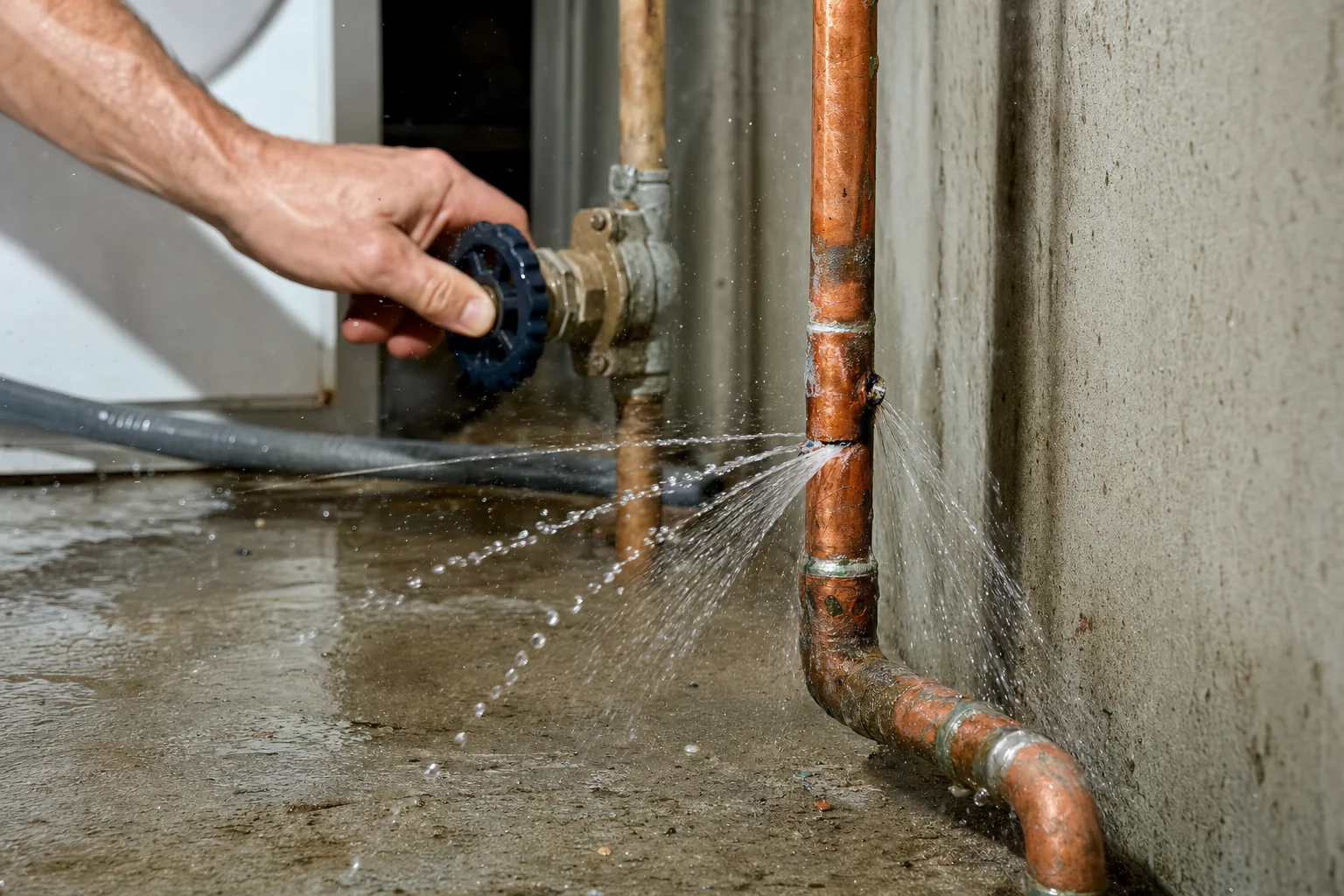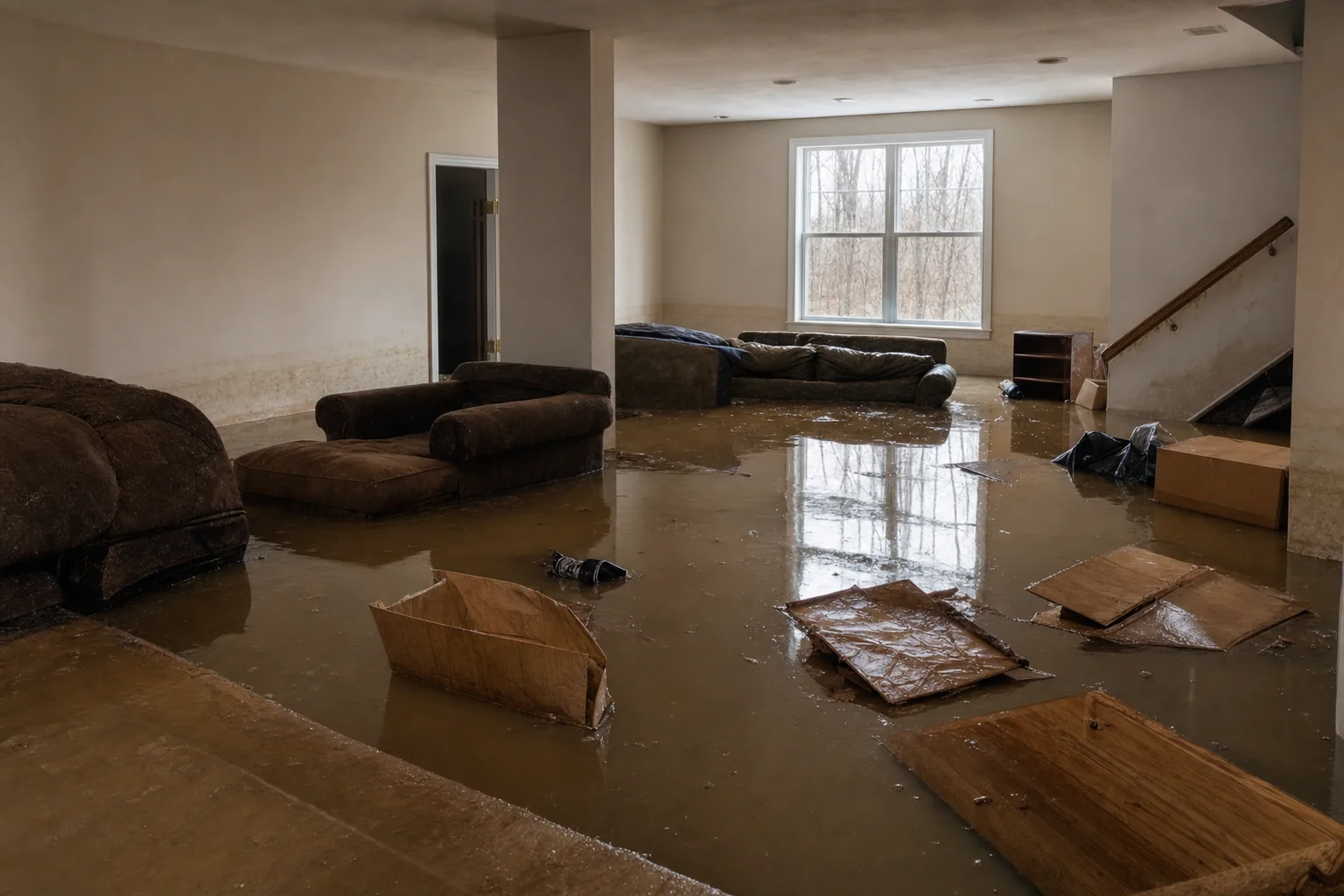
High-rise condos in Tysons and Arlington flood for one core reason: in a stacked vertical building, water always travels down, so a single failure—a burst supply line, a failed water heater, an overflowing tub, or a cracked HVAC condensate pan—can cascade through multiple units below in minutes. Unlike a single-family home, where a leak stays inside your four walls, a high-rise water loss is almost never your problem alone. The most important first move is to shut off the water at the unit's isolation valve, call the building's front desk or 24/7 engineer to kill the riser if needed, and get a professional restoration crew on site before the moisture spreads into the units below.
If you own or rent a condo in a Tysons or Rosslyn tower, this guide explains why these buildings are so prone to water damage, what to do in the first critical minutes, how responsibility splits between you and the condo association, and what cleanup typically costs. We respond to high-rise condo water damage across Northern Virginia constantly, and the buildings here share a predictable set of failure points worth understanding before one surprises you at 2 a.m.
Why Do High-Rise Condos Flood More Than Houses?
High-rise condos do not necessarily spring more leaks than houses—but when they do leak, the damage is dramatically larger, faster, and harder to contain. Three structural realities drive this: gravity, shared plumbing, and concealment.
Gravity Turns One Leak Into Many
In a vertical building, water that pools on a 14th-floor bathroom floor finds the path of least resistance—floor penetrations, plumbing chases, conduits, expansion joints—and travels down through the slab into the unit below, then the one below that. A single overflowing washing machine can soak several stacked units before anyone notices; in a house, it would have ruined one floor.
Shared Risers and Common Plumbing
Condo towers are plumbed with vertical "risers"—the main supply and drain stacks that serve every unit in a column. A failure in a shared riser, a pressure surge, or a backed-up common drain line affects every unit tied to that stack, not just one owner's fixtures. Because these lines run inside walls and chases that belong to the association, a homeowner often cannot even reach the failure point without building staff—the single biggest difference between condo and house water damage.
Concealed Slabs, Chases, and Stack Walls
High-rise construction hides water exceptionally well. Concrete slabs, drop ceilings, and double "stack walls" around plumbing let water travel laterally and downward for hours before it stains a ceiling or buckles a floor. By the time a downstairs neighbor sees a brown ring spreading across their ceiling, the assembly above may have been saturated for a full day—and that hidden moisture is exactly what feeds mold if it is not dried professionally.
The Most Common Causes of High-Rise Condo Water Damage
After enough calls into the towers of Tysons, Rosslyn, and the Ballston–Clarendon corridor, the same culprits appear again and again. Knowing them lets you watch your unit's weak points.
- Burst or failed supply lines: The braided hoses and small lines feeding sinks, toilets, dishwashers, and icemakers are the number-one source of sudden condo floods, failing silently while owners are away.
- Water heater failures: Most condos house a heater in a closet, often with no floor drain, so a corroded tank or failed fitting pours its contents onto the slab.
- HVAC condensate overflows: Clogged condensate lines back up during humid Northern Virginia summers—a slow, sneaky leak that ruins ceilings below.
- Overflowing tubs, toilets, and appliances: A stuck toilet float or a dishwasher gasket failure sends clean water across the floor and through the slab.
- Washing machine hose failures: A single ruptured fill hose can release hundreds of gallons.
- Shared riser and common-drain failures: Pressure surges, frozen rooftop lines, and clogged main stacks are the association's responsibility but land in residents' units.
- Sprinkler discharges: A bumped or corroded fire sprinkler head can release high-volume water fast, soaking multiple units at once.
- Roof, envelope, and balcony leaks: Top-floor units and those near balcony doors take on wind-driven rain during storms that roll through the Potomac corridor.
The most expensive condo losses are rarely the dramatic ones. A pipe that bursts while you are home gets shut off in minutes; the damage that bankrupts a budget comes from slow, hidden leaks that run for days until moisture has migrated into the slab and the units below. Investigate musty smells, ceiling discoloration, and warped flooring immediately rather than waiting to "see if it gets worse."
What to Do in the First 15 Minutes of a Condo Flood
Your actions in the first quarter hour determine whether this is a one-room dry-out or a multi-unit reconstruction. Follow these steps in order:
AZA Restoration answers 24/7 with a guaranteed 90-minute on-site response across Fairfax, Loudoun, Prince William, Stafford, Fauquier, and Arlington counties — plus Alexandria, Falls Church, Herndon, Manassas, and Manassas Park. We bill your insurance directly.
Call (571) 506-6668- Stop the water at the source. Shut off the fixture's local valve, or your unit's main isolation valve—every condo has one, usually in a utility closet, laundry area, or near the water heater. Know where yours is before an emergency.
- Call the building's front desk or 24/7 engineer. In a true gusher, they can shut down the riser serving your stack. Save their number in your phone now.
- Warn the units below you. Water is already heading their way, and early warning lets them move belongings and protect electronics.
- Cut power to wet areas at the breaker if you can do so without standing in water. Never touch a panel or outlet while standing in water.
- Move valuables and document everything. Get electronics and documents off the floor, then photograph the damage before cleanup—you will need it for your claim and the association's insurer.
- Call a professional restoration team. The faster extraction and drying begin, the fewer units are affected and the less chance mold takes hold.
For a deeper walkthrough, our breakdown of the burst-pipe response in a Tysons high-rise shows how a coordinated multi-unit dry-out unfolds from the first extraction pass to final moisture verification.
Water is moving through your building right now, and every minute it sits it spreads to more units. Call AZA Restoration at (571) 506-6668 for 24/7 emergency response with a guaranteed 90-minute on-site arrival across Northern Virginia. We extract, contain, and dry fast—and we bill your insurance directly. One call rebuilds it all.
Who Pays? Unit Owner vs. Condo Association Responsibility
This is the question that causes the most stress in a condo water loss. The short answer: responsibility usually splits along the line between the building's common elements and your unit's interior, but the exact boundary is set by your condominium's governing documents and Virginia law.
The association is generally responsible for shared vertical risers, main supply lines, and common drain stacks inside the walls and chases, plus the roof, exterior envelope, structural slabs, and common-area mechanical systems. The unit owner is generally responsible for the fixtures, appliances, and lines that serve only their unit—the toilet, the dishwasher, the water heater—along with interior finishes such as flooring, drywall, cabinets, and paint, personal property, and any upgrades made beyond the original build.
The wrinkle is that liability and insurance coverage do not always follow the same line. If your dishwasher hose fails and floods three units below you, the master policy, your individual HO-6 policy, and your neighbors' policies may all come into play, sometimes with subrogation between insurers afterward. This is why thorough documentation and a restoration partner who has navigated condo claims matter so much. AZA Restoration bills insurance directly and produces the detailed scope, photos, and moisture logs that keep these multi-party claims moving—our overview of water damage restoration and insurance walks through what to expect.
The Practical Rule for Residents
Do not let the question of who pays delay the cleanup—mold and structural damage do not wait for an insurance determination. The right sequence is: stop the water, document the loss, start professional extraction and drying immediately, and let the insurers and association sort out cost allocation afterward. Delaying remediation to "figure out fault" almost always makes the final bill larger.
High-Rise Condo Water Damage Costs and Timelines
Condo water losses follow the same market ranges as other water damage, but the multi-unit dimension and high-rise access logistics often push jobs toward the upper end. The table below shows typical ranges for Tysons and Arlington towers—these are ranges, not quotes, and an on-site assessment is the only way to price your loss.
| Scenario | What it usually involves | Typical cost range | Typical timeline |
|---|---|---|---|
| Localized single-unit leak | Clean-water extraction and structural drying of one room or area | $1,200–$5,500 | 3–5 days to dry |
| Multi-unit cascade (clean water) | Extraction and drying across two or more stacked units | $8,000–$25,000+ | 3–5 days drying per unit, staged |
| Mold remediation | Containment and removal where moisture sat undetected | $500–$6,000; $10,000+ if widespread | 1–5 days |
| Sewage / drain backup (Category 3) | Contaminated-water removal, disinfection, porous-material removal | $1,500–$10,000+ | 5–10 days |
| Reconstruction after removal | Rebuilding finishes, drywall, flooring, cabinetry | $10,000 single room to $100,000+ major | Weeks, depending on scope |
Two high-rise-specific factors inflate timelines. First is access and logistics: equipment must come up service elevators on the building's schedule, and a company that has not worked in towers can stall for days on access alone. Second is concealed-moisture verification: drying a concrete slab and the assemblies around a plumbing stack takes longer than drying a wood-framed floor, because concrete releases moisture slowly.
Repair vs. Replace in a Condo: What Can Be Saved?
The same principle that governs all water damage applies in a tower: the cleaner the water and the faster the response, the more can be dried in place and saved. Concrete slabs and structural elements are dried in place rather than replaced. Hardwood and engineered flooring is often salvageable if dried within the first day or two, before cupping sets in, and cabinetry and trim are frequently restorable when the water was clean. By contrast, carpet padding acts like a sponge and is discarded, wet drywall is cut out to a measured line above the moisture, trapped insulation is removed, and any porous material touched by Category 2 or 3 water is removed for health reasons regardless of how new it is.
The high-rise twist is the ceiling below: when water comes down through a slab, the downstairs neighbor's ceiling drywall, light fixtures, and insulation are often the most damaged materials in the entire event. A proper scope always inspects and addresses the units below the source, not just the unit where the leak began.
The Northern Virginia High-Rise Angle: Tysons, Rosslyn, and Local Code
Tysons and the Arlington corridor have seen a building boom of residential towers over the past two decades, and that vertical density shapes how water damage behaves and how it must be repaired here.
A Dense Stock of Newer—and Aging—Towers
Tysons sits at the heart of Fairfax County's planned high-rise growth, with towers clustered around the Silver Line Metro stations. Across the Potomac corridor, Rosslyn and the Ballston–Clarendon corridor hold some of the region's tallest residential buildings. Many are new, but a significant share date to earlier building cycles, where aging supply lines, original water heaters, and decades-old condensate systems are reaching the end of their service life. We respond to both brand-new towers with construction-defect leaks and older buildings with worn-out plumbing, and our Tysons service area coverage is built specifically around these high-rise response needs.
Climate, Humidity, and the Potomac Corridor
Northern Virginia's humid summers drive heavy condensate loads through fan-coil and air-handler systems, making clogged condensate lines among the most common warm-season leaks in towers. The region also catches the tail end of tropical systems and summer thunderstorms moving up the Potomac watershed, producing wind-driven rain that finds balcony doors, windows, and roof penetrations on upper floors. High-rise water damage here is seasonal: supply-line and heater failures cluster in winter freeze-thaw cycles, while condensate and storm-envelope leaks spike in summer.
Permits and the Virginia Uniform Statewide Building Code
When a condo loss is limited to drying and like-for-like surface repairs—replacing the same drywall, repainting, swapping flooring—a permit is usually not required. But high-rise reconstruction often crosses into permit territory fast, because the work touches plumbing risers, electrical, or structural assemblies governed by the Virginia Uniform Statewide Building Code (USBC). In Fairfax County, those permits run through Fairfax County Land Development Services; in Arlington, through the county's permit office. High-rise buildings also carry additional fire and life-safety requirements, so rebuild work near sprinklers, fire-rated assemblies, or shared mechanical systems must be done to code and inspected. As a Class A licensed restoration and general contractor, AZA Restoration pulls the required permits and rebuilds to code—so a water loss does not become a compliance problem when you sell or when the association audits the repair.
How to Prevent High-Rise Condo Water Damage
You cannot control a shared riser, but you can dramatically reduce the odds and severity of an in-unit failure. These are the highest-value habits for tower residents:
- Know where your isolation valve is and test that it actually turns. In an emergency, you will not have time to search.
- Replace rubber appliance hoses with braided stainless steel and inspect them yearly. Most catastrophic in-unit floods start at a $10 hose.
- Install leak detectors under sinks, behind the water heater, and at the washing machine. Inexpensive battery and Wi-Fi sensors buy crucial early warning.
- Service your HVAC condensate line before summer, and replace an aging water heater proactively—a planned swap is far cheaper than the flood that follows a corroded tank.
- Shut off your unit's water before extended travel and report musty odors or ceiling stains immediately. A line that fails while you are away is how single leaks become disasters.
What Professional High-Rise Restoration Looks Like
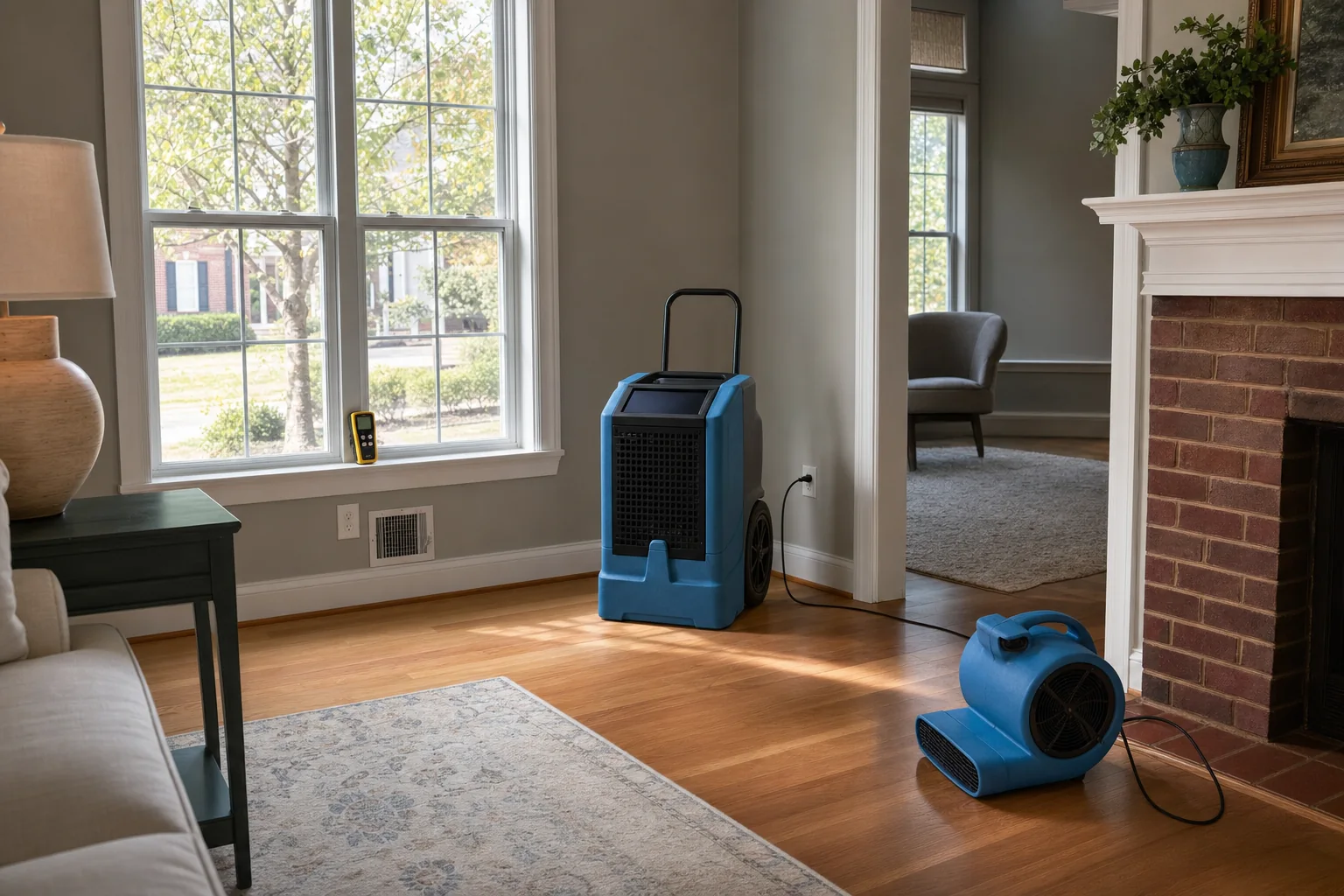
When our crew arrives at a tower, we confirm the source is stopped, identify every affected unit—not just the source unit but each one below it—then extract standing water, set commercial air movers and dehumidifiers, and monitor moisture in the slab and surrounding assemblies daily until everything reaches a verified dry baseline, remediating mold under containment where needed. Because we are a full restoration and general contractor, the same team handles reconstruction—drywall, ceilings, flooring, and cabinetry, built to code with required permits pulled—so condo owners juggling their own insurer, the association's carrier, and downstairs neighbors deal with one accountable team from emergency response through final rebuild.
A high-rise leak only gets bigger and more expensive the longer it waits. AZA Restoration responds 24/7 across Tysons, Rosslyn, Arlington, and all of Northern Virginia with a guaranteed 90-minute on-site arrival, direct insurance billing, and crews experienced in multi-unit condo losses. Call (571) 506-6668 now—we will stop the spread, dry it right, and rebuild it to code. One call rebuilds it all.
Frequently Asked Questions
Who is responsible for water damage in a condo—the owner or the association?
Responsibility generally splits between the building's common elements and your unit's interior. The association is usually responsible for shared risers, main lines, the roof, the exterior envelope, and structural slabs, while the unit owner is responsible for in-unit fixtures, appliances, interior finishes, and personal property. The exact line is set by your condominium's governing documents and Virginia condominium law, and insurance liability does not always match that boundary—your HO-6 policy, the master policy, and neighbors' policies can all be involved. Document the loss and start cleanup immediately rather than waiting for a fault determination.
How much does high-rise condo water damage restoration cost?
A localized single-unit clean-water loss typically runs $1,200 to $5,500, while a multi-unit cascade affecting stacked units commonly ranges from $8,000 to $25,000 or more. Mold remediation runs $500 to $6,000 and can exceed $10,000 if widespread, and contaminated-water (Category 3) cleanups range from $1,500 to $10,000 or more. Reconstruction after material removal ranges from about $10,000 for a single room to $100,000 or more for a major rebuild. These are typical market ranges; an on-site assessment provides an accurate estimate.
What should I do first if my condo floods?
Shut off the water at your fixture's local valve or your unit's main isolation valve, then call the building's front desk or 24/7 engineer so they can shut down the riser if needed. Warn the neighbors directly below you, because water is already heading their way. Cut power to wet areas only if you can do so safely, move valuables off the floor, photograph the damage for your claim, and call a professional restoration team to begin extraction and drying right away.
Why does water from an upstairs condo damage units below?
In a vertical building, escaped water follows gravity through floor penetrations, plumbing chases, conduits, and slab seams, traveling down into the units beneath the source. A single overflow or burst line on an upper floor can soak several stacked units before anyone notices, and the downstairs neighbors' ceilings, fixtures, and insulation are often the most damaged materials in the whole event. A proper restoration scope inspects and addresses every affected unit, not just the one where the leak began.
Will my insurance cover a condo water leak that affects other units?
It depends on your policy and the cause of the loss, but condo claims often involve multiple insurers at once—your individual HO-6 policy, the association's master policy, and the affected neighbors' policies—sometimes with subrogation between carriers afterward. Many policies cover sudden and accidental water damage, while gradual leaks may be treated differently. AZA Restoration bills insurance directly and produces the detailed scope, photos, and moisture documentation that keep multi-party condo claims moving. Call us to review your situation before you begin cleanup.
How long does it take to dry out a high-rise condo after water damage?
Structural drying of a typical clean-water loss takes about three to five days per unit, but high-rise jobs often run longer because concrete slabs release moisture slowly and crews must coordinate elevator access and entry to multiple units. Contaminated-water losses take five to ten days, and any necessary reconstruction adds weeks. Our crews monitor moisture daily and do not consider a unit finished until it reaches a verified dry baseline.