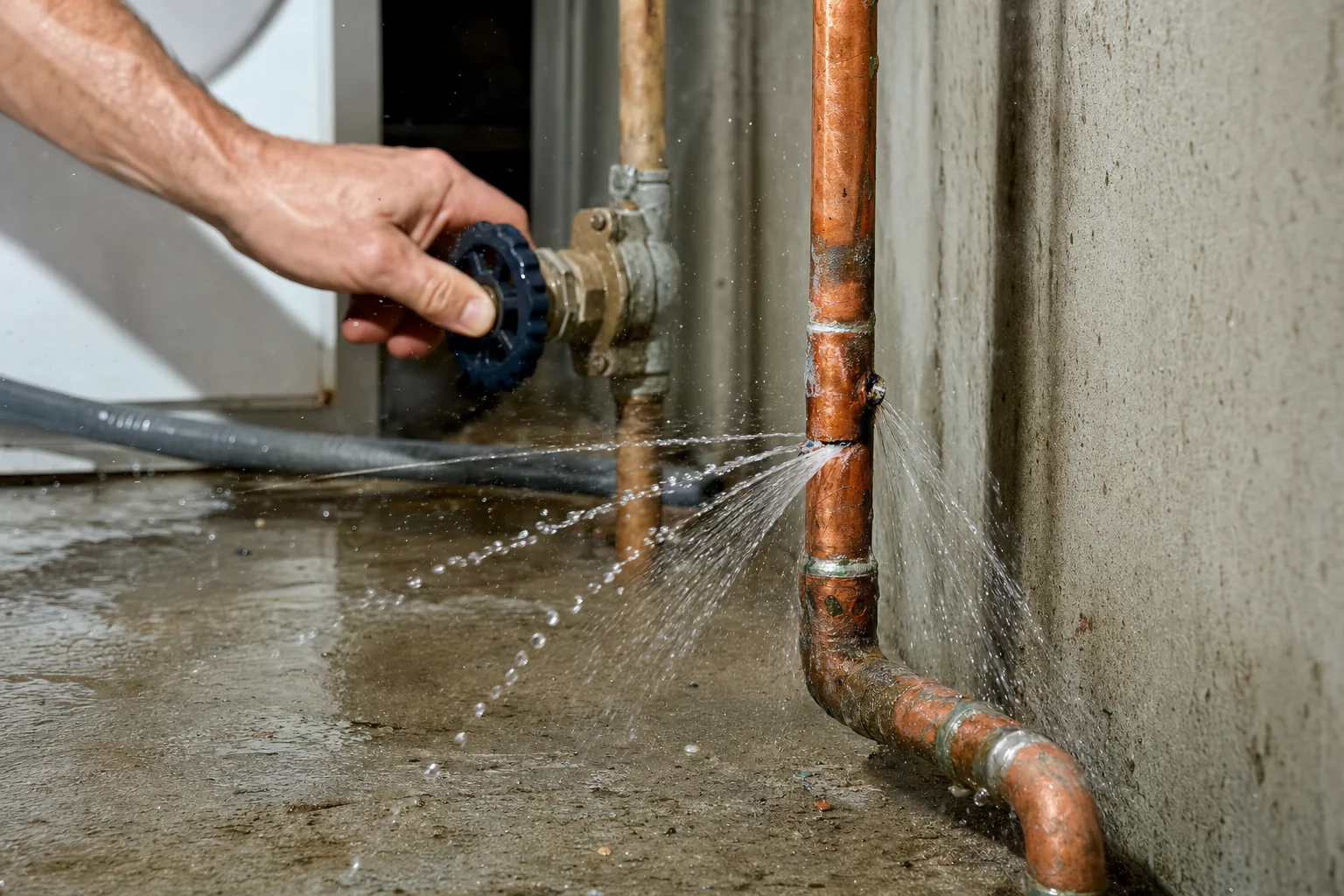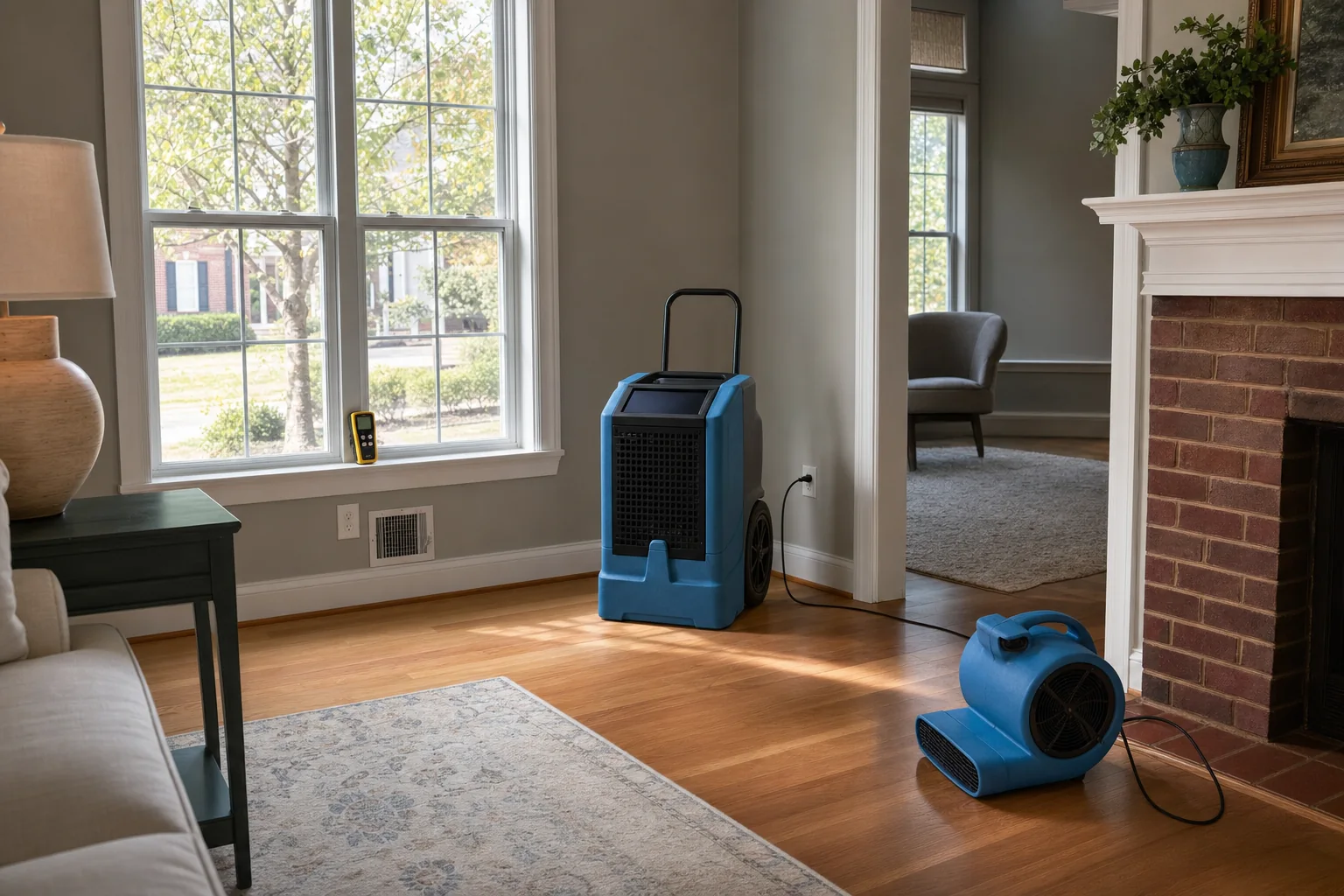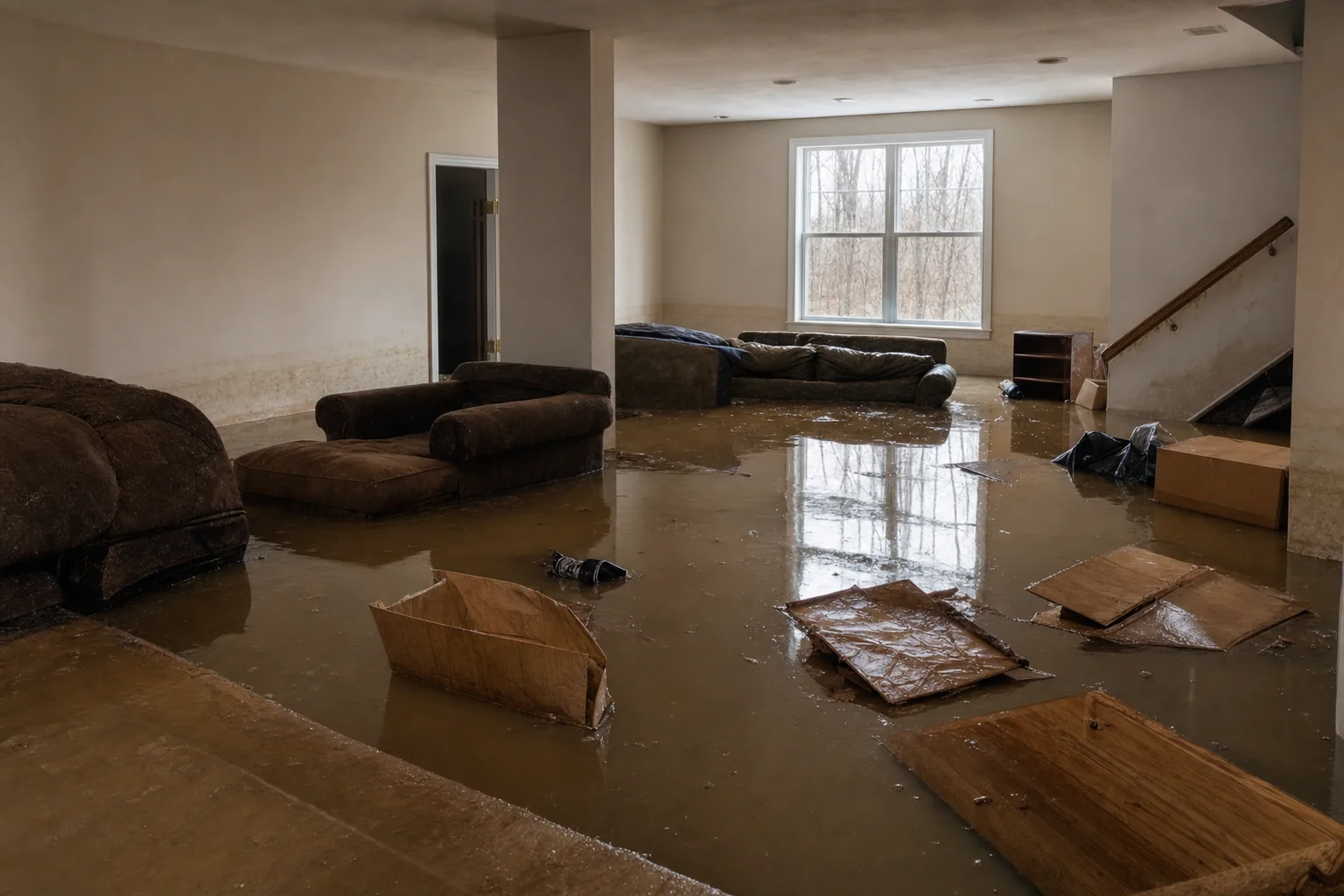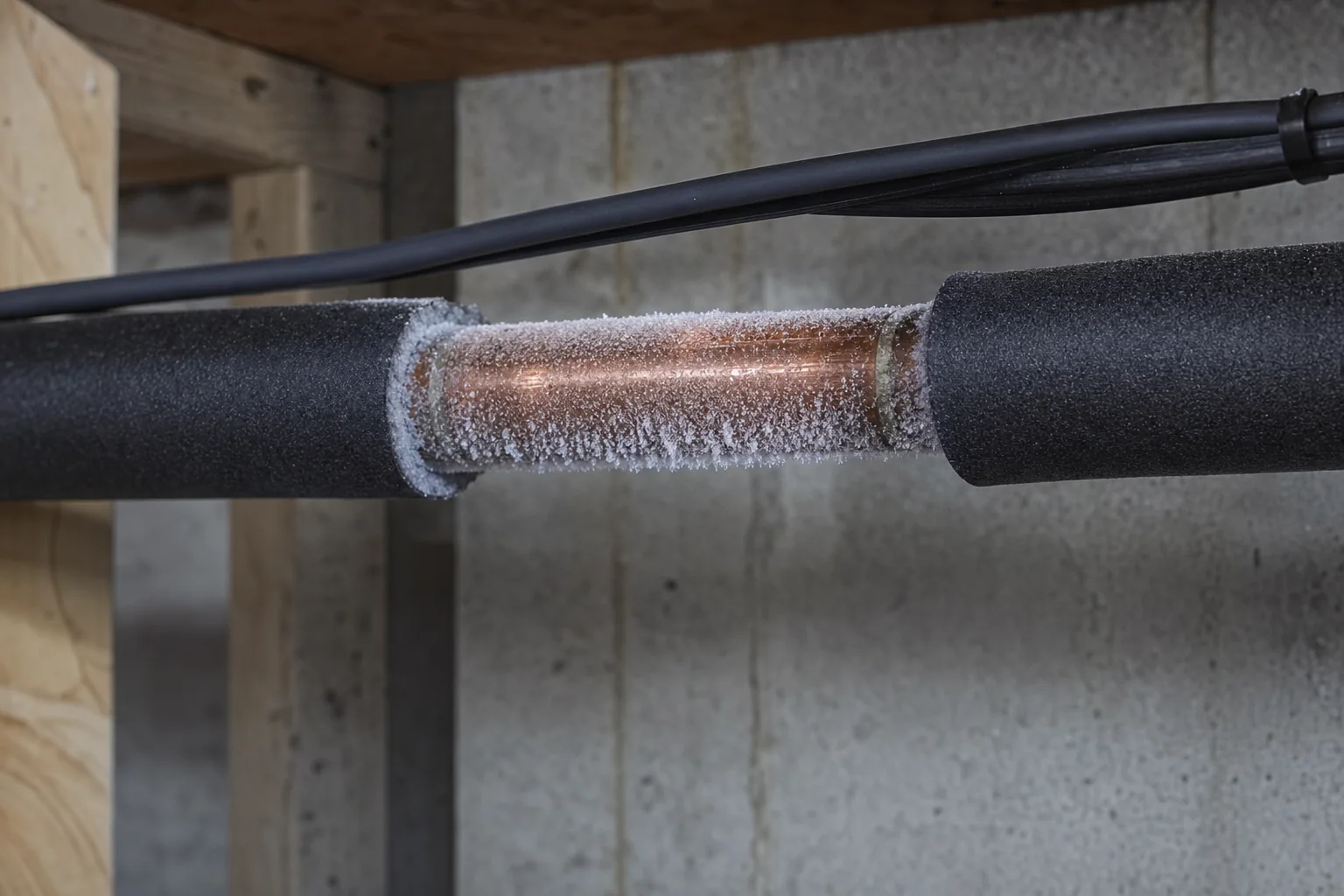
To prevent frozen pipes from bursting in Virginia, keep your home heated above 55°F day and night, insulate any pipe running through an unheated space, seal cold-air drafts near plumbing, and let a thin stream of water trickle from vulnerable faucets during a hard freeze. A pipe bursts because water expands roughly 9% as it freezes, and the pressure that builds between the ice plug and a closed faucet can split copper, PEX, or galvanized steel. If a pipe does freeze, thaw it slowly with gentle heat and an open faucet, never an open flame, and shut off your main water valve the instant you see or hear water escaping. When a line has already burst, fast water extraction and structural drying within the first 24 to 48 hours are what stand between a contained repair and a mold-driven gut renovation.
In Northern Virginia, frozen-pipe failures cluster into a few brutal cold snaps each winter, when an Arctic front drops temperatures into the single digits across Fairfax, Loudoun, Prince William, and Stafford counties. The homes that flood are rarely the ones that stayed cold longest. They are the ones with one overlooked pipe in a garage, crawl space, or exterior wall, plus a homeowner who was traveling or asleep when the line let go. This guide explains why pipes burst here, how to prevent it, how to thaw a frozen line safely, and what professional water damage restoration looks like after a burst.
Why Do Pipes Freeze and Burst in Virginia Winters?
Pipes burst because of pressure, not because of the ice touching the pipe wall. When water inside a pipe freezes, it forms an ice plug that grows and seals the line. As more water behind that plug freezes and expands, it pushes pressure forward toward the nearest closed faucet. With nowhere to vent, that pressure can exceed 2,000 pounds per square inch, far beyond what residential plumbing is rated to hold. The pipe then fails at its weakest point, frequently inches away from the actual ice blockage rather than at the freeze itself.
Northern Virginia sits in a transitional climate zone that is, counterintuitively, harder on plumbing than consistently cold regions. Many homes across Fairfax, Arlington, and Loudoun were built for mild winters and only occasionally face the kind of polar outbreak that pushes the Potomac and Occoquan watersheds into hard freeze conditions. When that happens, under-insulated pipes that performed fine for years can fail all at once.
Which pipes are most at risk in a typical NoVA home?
The most vulnerable plumbing shares one trait: it runs through an unconditioned, poorly insulated, or wind-exposed space. In Northern Virginia homes, the recurring trouble spots are:
- Exterior hose bibs and outdoor spigots — the single most common burst point, especially when a hose is left attached and traps water against the valve.
- Garage plumbing — pipes feeding utility sinks or running along an exterior garage wall, since attached garages rarely stay above freezing.
- Crawl space and basement rim-joist runs — common in older Fairfax and Prince William County homes with vented crawl spaces.
- Pipes inside exterior walls — particularly on the north and west sides that take the brunt of winter wind.
- Unheated additions, sunrooms, and bonus rooms — spaces shut off from central heat to save on energy bills.
- Vacation homes and rentals — properties in Fauquier and Stafford counties left empty with the heat turned too low.
At what temperature do pipes actually freeze?
The often-cited threshold is 20°F. Pipes in exposed or unprotected areas are at meaningful risk once the outdoor temperature drops to 20°F or below, especially with wind chill driving cold air through gaps in the building envelope. An insulated interior pipe can survive much colder air, while a wind-exposed pipe in an uninsulated wall can freeze closer to the high 20s. The variables that matter most are how long the cold persists, whether wind is forcing cold air against the pipe, and whether water is moving through the line. Standing water freezes far faster than moving water, which is why a faucet drip is such an effective defense.
How Can You Prevent Frozen Pipes Before a Freeze?
Frozen pipe burst prevention comes down to three jobs: keep heat on the pipes, keep cold air off them, and keep water moving when the temperature plunges. Most prevention is inexpensive and takes an afternoon, far cheaper than the $1,200 to $5,500 a localized burst typically costs to repair.
Before winter: a seasonal prevention checklist
- Disconnect and drain all garden hoses and store them indoors. A connected hose traps water in the spigot and is a leading cause of frozen, split outdoor faucets.
- Shut off and drain exterior spigots at their interior shutoff valve if your home has frost-free or separately valved hose bibs.
- Insulate exposed pipes with foam pipe sleeves in garages, crawl spaces, basements, and unheated areas, paying special attention to pipes near exterior walls.
- Seal air leaks around rim joists, foundation vents, and points where pipes pass through exterior walls. Even a small draft of subfreezing air can freeze a nearby pipe.
- Add heat tape or heat cable to chronically problematic pipes, using only UL-listed products per the manufacturer's instructions.
- Locate and label your main water shutoff valve now, so every adult in the household can find it in the dark during an emergency.
- Service your heating system so a furnace failure during a cold snap doesn't leave the whole house unprotected.
During a hard freeze: what to do when the forecast turns Arctic
When a National Weather Service hard-freeze or wind-chill warning hits Northern Virginia, take these immediate steps:
- Keep the thermostat at 55°F or higher at all times, including overnight and while away. Do not set back the heat to save money during a freeze.
- Open cabinet doors under kitchen and bathroom sinks, especially on exterior walls, so warm room air can reach the pipes.
- Let vulnerable faucets drip a pencil-thin stream of cold water. Moving water resists freezing and relieves pressure even if a partial ice plug forms. Prioritize the faucet farthest from where the supply line enters the house.
- Keep the garage door closed if there is plumbing in or along the garage.
- Open interior doors to let heat circulate evenly to rooms with plumbing on exterior walls.
Pipe already frozen, leaking, or burst? Don't wait for it to thaw on its own. Call AZA Restoration now at (571) 506-6668 for 24/7 emergency response with guaranteed 90-minute on-site arrival across Northern Virginia. We bill your insurance directly so you can focus on protecting your home. One call rebuilds it all.
How Do You Safely Thaw a Frozen Pipe?
To safely thaw a frozen pipe, open the affected faucet, apply gentle heat to the frozen section starting from the faucet end and working back toward the freeze, and watch closely for leaks as the ice melts. The open faucet gives melting water somewhere to go and signals when flow returns. Never use an open flame, a blowtorch, or a propane heater on a pipe. Direct flame can crack the pipe, ignite nearby framing, and is a frequent cause of house fires during cold snaps.
Step-by-step: thawing a frozen pipe
- Open the faucet served by the frozen pipe, both the hot and cold handles, so meltwater and steam can escape and pressure can release.
- Find the frozen section. It's often the coldest, frost-covered, or bulging stretch of pipe along an exterior wall, in a cabinet, or in a crawl space.
- Apply gentle, even heat using a hair dryer, a heating pad wrapped around the pipe, towels soaked in hot water, or a portable space heater kept a safe distance from combustibles.
- Work from the faucet toward the freeze so melting ice can drain out the open faucet instead of being trapped behind a new ice plug.
- Keep heating until full water pressure returns. Then check the entire run for cracks or weeping joints, since damage may not show until flow resumes.
- If you can't locate or reach the frozen section, or if the pipe has already split, shut off the main water valve and call a professional.
What to do the moment a pipe bursts
If a pipe has already burst, speed matters more than anything. Act in this order:
- Shut off the main water supply immediately. This is the single most important action and the reason to locate that valve in advance.
- Open faucets to drain remaining water from the system and relieve pressure.
- Cut electricity to affected areas at the breaker if water is near outlets, wiring, or your electrical panel. Do not enter standing water that may be electrified.
- Move valuables, electronics, and furniture out of the water and lift soft goods off wet flooring.
- Document everything with photos and video before cleanup begins, which your insurer will want.
- Call for emergency restoration so extraction and drying can start before water wicks into drywall, subfloor, and framing.
The window that determines how bad a burst-pipe loss becomes is short. Water migrates through drywall, insulation, and subflooring within hours, and mold can begin colonizing damp organic material in as little as 24 to 48 hours. That is why our emergency restoration team is built around the guaranteed 90-minute arrival standard. Getting extraction equipment on site quickly is often the difference between drying a room and demolishing one.
What Happens After a Pipe Bursts: The Restoration Process
Professional burst-pipe restoration follows a defined sequence: stop ongoing damage, remove water, dry the structure to a measurable target, and rebuild what can't be saved. Understanding the process helps you know what to expect.
Step 1: Emergency mitigation and water extraction
The first priority is stopping the source and removing standing water. Trained restoration specialists confirm the water is shut off, then use truck-mounted and portable extractors to pull water from floors, carpet, and pooled areas. Fast, thorough water extraction and drying dramatically reduces how far water spreads into building materials.
Step 2: Assessment and moisture mapping
Water hides. It travels under flooring, behind baseboards, up wall cavities, and into insulation where it isn't visible. Technicians use moisture meters and thermal imaging cameras to map the full extent of saturation, then set measurable dry-down targets based on industry restoration standards. This prevents the classic mistake of drying what you can see while leaving hidden moisture to feed mold.
Step 3: Structural drying and dehumidification
Air movers and commercial dehumidifiers create controlled airflow and pull moisture out of materials and the air. Structural drying typically runs 3 to 5 days, with daily moisture readings tracking progress. Materials are dried to documented benchmarks rather than removed by guesswork, which keeps costs down and preserves as much of your home as possible.
Step 4: Removal of unsalvageable materials
Some materials cannot be dried in place. Saturated insulation, swollen particleboard, and drywall that has wicked water for too long usually need controlled removal. Decisions here drive the repair-versus-replace tradeoff covered below.
Step 5: Repairs and reconstruction
Once the structure is dry and verified, reconstruction restores your home: new drywall, insulation, flooring, trim, and paint. Because AZA Restoration is a Class A licensed restoration and general contractor, the same team that dries your home rebuilds it, so there's no handoff gap between mitigation and reconstruction. That continuity is the heart of our slogan, "One call rebuilds it all."
Repair vs. Replace: What Can Be Saved After Water Damage?
Whether a material can be dried and saved or must be replaced depends on what it's made of, how long it stayed wet, and whether the water was clean. Burst supply lines usually release clean water, the best-case scenario, which widens the range of what can be salvaged. The table below reflects typical outcomes for a clean-water burst addressed quickly.
| Material | Typical Outcome | Why |
|---|---|---|
| Hardwood flooring | Often salvageable if dried fast | Can cup or warp but frequently recovers with specialized drying mats if addressed within 24 to 48 hours. |
| Drywall (clean water, brief exposure) | Often dryable in place | Can be dried with airflow if exposure was short; lower 1 to 2 feet sometimes cut and replaced. |
| Drywall (prolonged saturation) | Usually replaced | Loses structural integrity and holds moisture that feeds mold. |
| Carpet (clean water) | Often salvageable | Can be extracted and dried; the pad underneath is usually replaced. |
| Insulation (fiberglass or cellulose) | Usually replaced | Mats down, loses R-value, and retains moisture against framing. |
| Particleboard / laminate flooring | Usually replaced | Swells and delaminates permanently once saturated. |
| Solid wood framing / studs | Almost always dried and saved | Structurally sound once dried to target moisture content. |
| Electrical components touched by water | Replaced | Safety risk; outlets, wiring, and panels exposed to water require evaluation. |
The single biggest factor in that table is time. A drywall panel touched by clean water for two hours behaves completely differently than one that sat wet for two days. That is the core economic argument for fast professional response: every hour of delay shifts more materials from the salvageable column into the replace column.
What Does Burst-Pipe Water Damage Cost in Northern Virginia?
A localized burst-pipe cleanup and repair in Northern Virginia typically runs from $1,200 to $5,500, while major or whole-home water damage from a pipe that ran unchecked can reach $8,000 to $25,000 or more. The spread is enormous because it's driven almost entirely by how long the water ran and how far it traveled before being stopped and dried.
| Scenario | Typical Cost Range | Typical Timeline |
|---|---|---|
| Localized burst, caught quickly, one room | $1,200 – $5,500 | Structural drying 3 – 5 days |
| Major or whole-home water damage | $8,000 – $25,000+ | Drying days, then reconstruction over weeks |
| Mold remediation (if drying was delayed) | $500 – $6,000 (hidden/widespread $10,000+) | 1 – 5 days |
| Reconstruction (single room to major rebuild) | $10,000 single room – $100,000+ major | Weeks, depending on scope and permits |
These are typical market ranges, not quotes. Your actual cost depends on the size of the affected area, the materials involved, whether mold developed, and the scope of reconstruction.
How insurance and direct billing work
Most homeowners policies cover sudden, accidental water damage from a burst pipe, including extraction, drying, and reconstruction, subject to your deductible. Gradual leaks and damage traced to neglected maintenance are frequently excluded, which is another reason fast, documented response matters. AZA Restoration bills your insurance company directly, documents the loss with photos and moisture readings, and works with your adjuster so you aren't fronting large sums or fighting paperwork during a stressful week. Report the claim promptly, since most policies require timely notice.
Do You Need a Permit to Repair Burst-Pipe Damage in Virginia?
Whether you need a permit depends on the scope of the repair under the Virginia Uniform Statewide Building Code (USBC). Like-for-like drying and minor surface repairs, such as drying a room, replacing drywall, repainting, or swapping flooring, are generally exempt from permitting. However, structural repairs, electrical work, and plumbing modifications beyond a simple like-for-like fix typically require a permit from your local building office.
In Northern Virginia, that permit comes from your county or city building department. Fairfax County permits, for example, are handled by Land Development Services, while Loudoun, Prince William, Arlington, Stafford, and Fauquier counties each run their own building offices, as do cities like Alexandria, Falls Church, Manassas, and Manassas Park. The principle is consistent statewide: rebuilds that touch structure, wiring, or plumbing must be inspected and brought to code.
This is where working with a licensed restoration and general contractor pays off. AZA Restoration pulls the required permits, schedules inspections, and builds to current USBC standards, so your repaired home is both dry and compliant. An unpermitted structural or electrical repair can cause problems at resale and may complicate future insurance claims, so handling permits correctly protects your home's value and safety.
Why Local Northern Virginia Experience Matters
Burst-pipe response is a local problem with local variables. Northern Virginia's housing stock ranges from century-old homes in Alexandria and Falls Church with galvanized plumbing and vented crawl spaces, to newer construction in Loudoun and Prince William with PEX lines and conditioned spaces. Each presents different freeze risks and drying challenges. A team that works these counties every winter knows where water hides in a Fairfax split-level versus a Manassas townhome.
Geography matters during the freeze itself, too. Homes near the Potomac, Occoquan, and Bull Run waterways, and those in low-lying or wind-exposed areas, can see conditions colder than the regional forecast. When a polar outbreak sweeps the area, bursts happen across many homes at once and emergency demand spikes. A local contractor with crews positioned across Fairfax, Loudoun, Prince William, Stafford, Fauquier, and Arlington counties, plus Alexandria, Falls Church, Herndon, Manassas, and Manassas Park, can hold that 90-minute arrival standard when out-of-area companies are backlogged.
Frequently Asked Questions
At what temperature should I let my faucets drip?
Begin letting vulnerable faucets drip when the outdoor temperature is forecast to drop to 20°F or below, especially overnight or with significant wind chill. A pencil-thin stream of cold water keeps water moving through the pipe, which resists freezing and relieves the pressure that causes bursts. Prioritize faucets served by pipes running through exterior walls, garages, or unheated spaces, and the faucet farthest from where your water line enters the home.
Can I thaw a frozen pipe myself, or should I call a professional?
You can safely thaw an accessible frozen pipe yourself using gentle heat from a hair dryer, heating pad, or space heater while keeping the faucet open and working from the faucet toward the freeze. Never use an open flame. Call a professional if you cannot locate or reach the frozen section, if the pipe has already burst, or if water is escaping into walls, ceilings, or floors. In those cases, shut off your main water valve and call AZA Restoration at (571) 506-6668.
How quickly does water damage need to be addressed after a pipe bursts?
Water damage should be addressed immediately, ideally within the first 24 to 48 hours. Water wicks into drywall, subfloor, insulation, and framing within hours, and mold can begin growing on damp organic materials in as little as one to two days. The faster extraction and structural drying begin, the more of your home can be saved and the lower the total cost, which is why AZA Restoration guarantees a 90-minute on-site arrival across Northern Virginia.
Does homeowners insurance cover burst pipe damage?
Most standard homeowners policies cover sudden and accidental water damage from a burst pipe, including extraction, drying, and reconstruction, subject to your deductible. Damage from gradual leaks or attributed to neglected maintenance is often excluded. Document the damage with photos and video, report the claim promptly, and keep all records. AZA Restoration bills insurance directly and works with your adjuster to streamline the process.
Will I need a permit to repair my home after a burst pipe?
Like-for-like drying and surface repairs, such as replacing drywall, flooring, and paint, are generally exempt from permitting under the Virginia Uniform Statewide Building Code. Structural, electrical, or plumbing repairs beyond a simple like-for-like fix typically require a permit from your county or city building office, such as Fairfax County Land Development Services. AZA Restoration pulls all required permits and builds to current code as part of the reconstruction process.
How can I prevent my pipes from freezing while I'm away in winter?
Never turn the heat off when traveling in winter. Set your thermostat no lower than 55°F, and for trips longer than a day or two, shut off your main water supply and consider draining the system. Disconnect outdoor hoses, insulate exposed pipes, and ask a neighbor to check the house daily during cold spells. A burst pipe in an empty home is one of the most expensive losses we see, because water can run unchecked for hours or days.
Frozen, leaking, or burst pipe in your Northern Virginia home? AZA Restoration is ready 24/7 with guaranteed 90-minute on-site arrival, professional water extraction and structural drying, and direct insurance billing. Our Class A licensed crews dry your home and rebuild it, all from one call. Phone (571) 506-6668 now. One call rebuilds it all.