Black mold removal cost in Northern Virginia typically runs from $500 to $6,000, with widespread or hidden infestations climbing past $10,000. Most homeowners pay somewhere in the middle of that range for a contained problem caught early, while jobs involving large wall cavities, HVAC contamination, or structural drying push toward the top. The single biggest factor is the affected square footage and whether the mold is surface-level or has penetrated drywall, framing, insulation, and subfloor. In this guide, AZA Restoration walks you through how to recognize black mold, what it actually does to your health, how professional remediation works step by step, and what you should realistically expect to pay in Fairfax, Loudoun, Prince William, Arlington, and the surrounding counties.
We restore mold-damaged homes across Northern Virginia every week, and the pattern is almost always the same: a hidden moisture source feeds a colony for weeks before anyone notices, then the visible patch on the wall turns out to be a fraction of what's growing behind it. Knowing the signs and the process up front helps you act before a $1,500 cleanup becomes a five-figure reconstruction project.
What Is Black Mold, and Is It Really Dangerous?
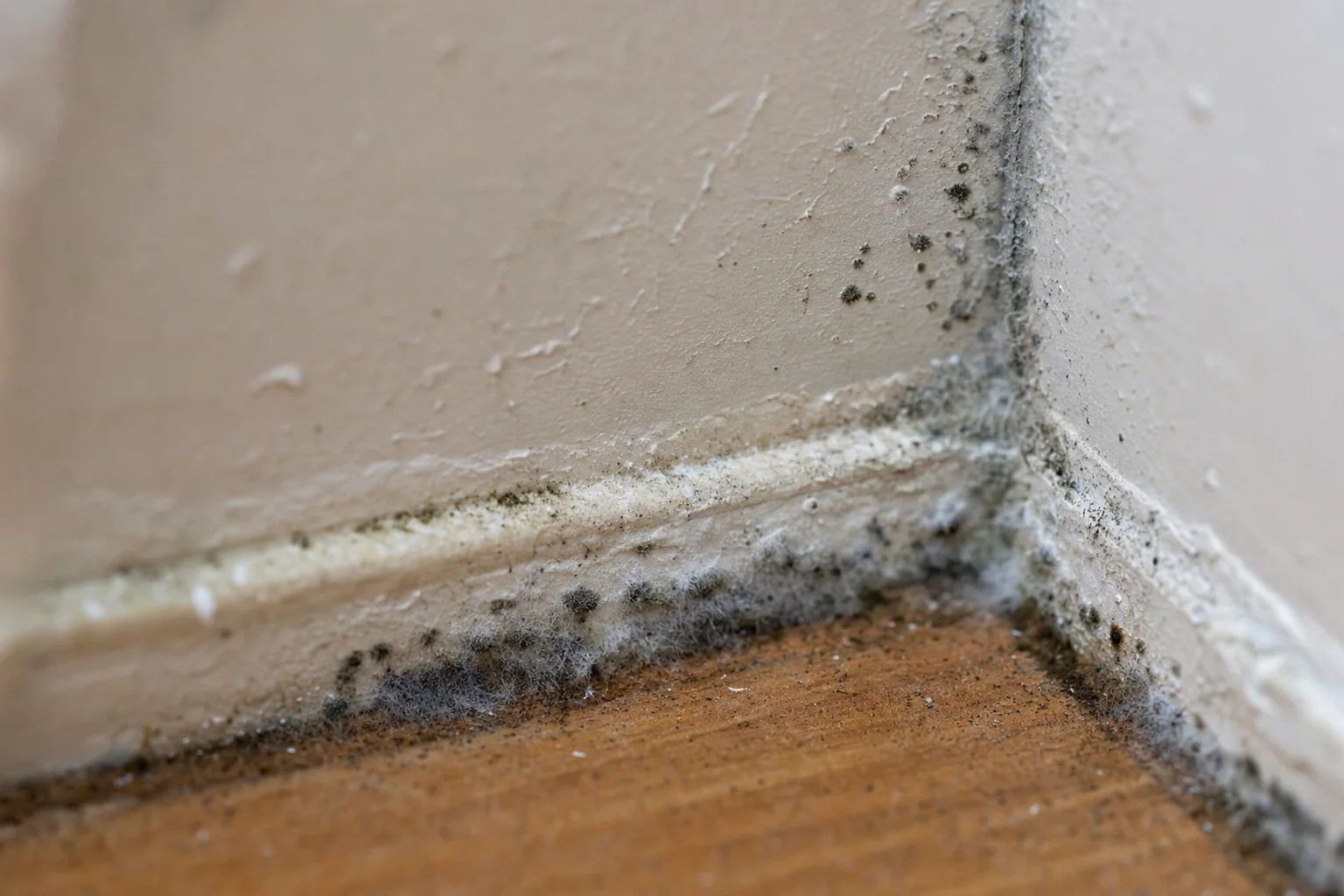
"Black mold" is the common name most people use for Stachybotrys chartarum, a dark greenish-black fungus that grows on cellulose-rich materials such as drywall, ceiling tiles, wood, and paper backing when they stay wet for several days. It is one of hundreds of mold species, but it earns its reputation because it thrives specifically on the constant moisture that follows water damage, and because it can produce mycotoxins. That said, not every dark patch is Stachybotrys, and color alone cannot identify a species. Many ordinary, less aggressive molds also look black or dark gray.
The honest, evidence-based answer is this: any mold growing indoors in significant quantity is a problem that should be removed, regardless of its exact species. You do not need a lab to confirm "black mold" before acting. If you can see or smell mold, the underlying moisture issue is real and the colony is spreading. For a fuller primer on how mold forms and the conditions it needs, our overview of what mold is and why it grows indoors explains the biology in plain terms.
Why Northern Virginia Homes Are Especially Vulnerable
Our region sits in a humid subtropical climate, and that matters more than most homeowners realize. Summer dew points routinely sit in the uncomfortable 70s, and the Potomac, Occoquan, and Bull Run watersheds keep groundwater high across Fairfax, Loudoun, Prince William, and Stafford counties. Basements and crawl spaces in older Arlington and Alexandria homes were rarely built with modern vapor barriers, so they pull in ground moisture year-round. Add the area's freeze-thaw cycles, which crack foundations and flashing, plus heavy summer thunderstorms and the occasional tropical remnant, and you have a climate practically engineered to grow mold. A small roof leak or a slow supply-line drip that would dry out in Arizona will feed an active colony here within 48 to 72 hours.
What Are the Signs of Black Mold in Your Home?
The earliest and most reliable sign of black mold is a persistent musty, earthy odor that gets stronger in enclosed or humid spaces, even when you cannot see anything. Mold off-gasses microbial volatile organic compounds, and your nose often detects a colony before your eyes do. Beyond the smell, watch for the following warning signs:
- Visible growth: black, gray, or greenish patches that may look fuzzy, slimy, or powdery on walls, ceilings, grout, window sills, or around plumbing fixtures.
- Staining and discoloration: dark spots bleeding through paint, water rings on ceilings, or warped, bubbling drywall and baseboards.
- A musty smell that won't quit in basements, crawl spaces, bathrooms, behind furniture, or near the HVAC return.
- Recurring condensation on windows, pipes, or interior walls, signaling the chronic humidity mold needs.
- Worsening allergy or respiratory symptoms that improve when you leave the house and return when you come home.
- Recent water damage history: a past leak, flood, or appliance overflow that was dried quickly on the surface but never fully addressed inside the wall or floor.
Where Black Mold Hides
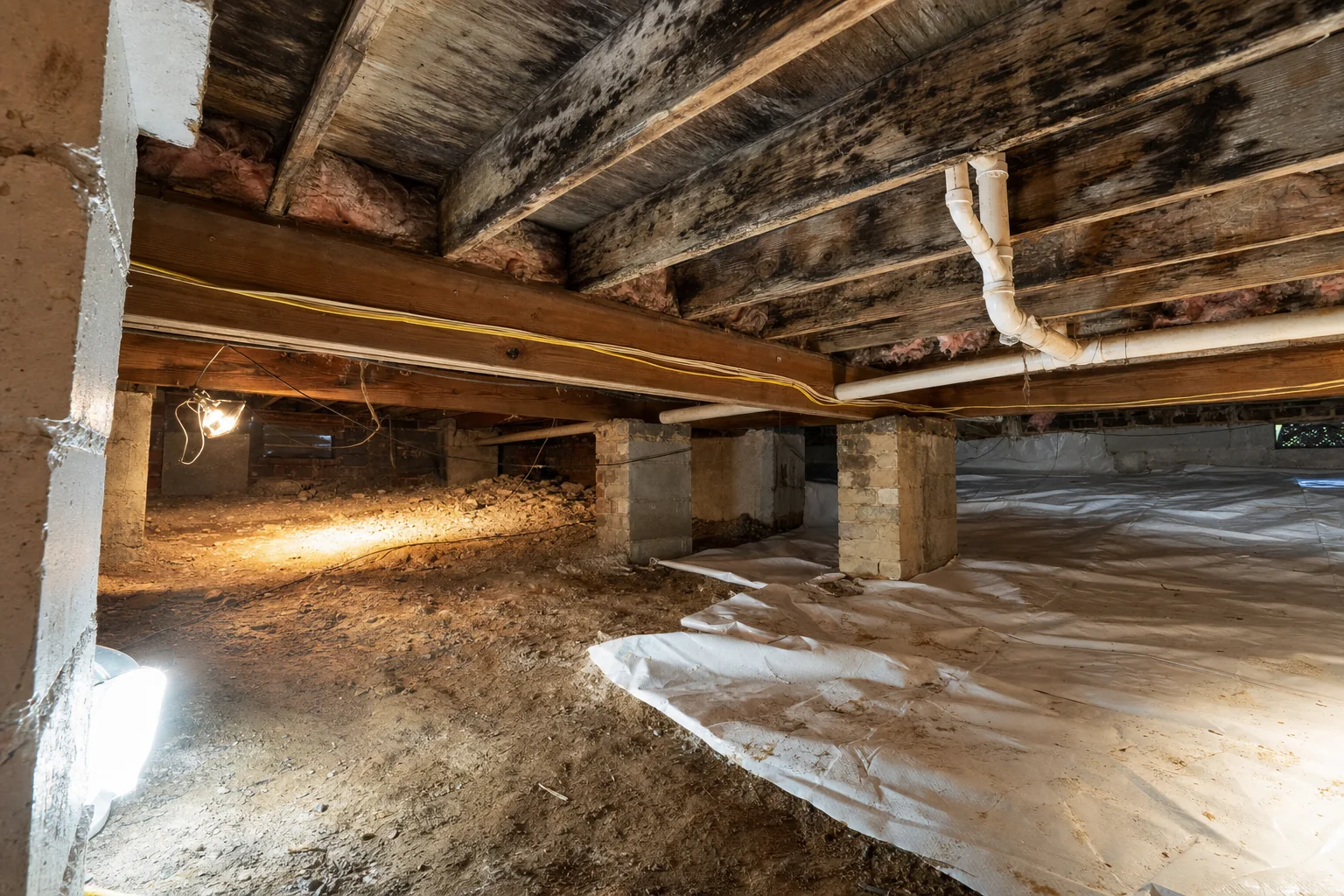
The visible patch is rarely the whole story. In our field experience, the worst colonies grow where moisture lingers and air doesn't circulate: behind drywall on exterior walls, under sink cabinets, beneath bathroom flooring, inside the paper backing of insulation, in crawl space joists, behind wallpaper, and inside HVAC ductwork and drip pans. When mold gets into the air handling system, the contamination can spread spores to every room the system serves, which is why a "small bathroom problem" sometimes turns out to be a whole-house issue.
What Are the Health Risks of Black Mold Exposure?
Black mold exposure most commonly causes allergy-like and respiratory symptoms, and the severity depends on the amount of exposure and your individual sensitivity. For the average healthy adult, ongoing exposure can trigger nasal congestion, sneezing, coughing, throat irritation, watery or itchy eyes, skin rashes, and headaches. People often describe simply feeling run-down or foggy at home and noticeably better when they're away for a few days.
AZA Restoration answers 24/7 with a guaranteed 90-minute on-site response across Fairfax, Loudoun, Prince William, Stafford, Fauquier, and Arlington counties — plus Alexandria, Falls Church, Herndon, Manassas, and Manassas Park. We bill your insurance directly.
Call (571) 506-6668Certain groups face higher risk. Infants and young children, older adults, people with asthma or chronic lung conditions, those with mold allergies, and anyone who is immunocompromised can experience more serious reactions, including asthma attacks, persistent sinus infections, and in rare cases respiratory infections. If anyone in your household has unexplained worsening respiratory symptoms alongside a musty home, treat it as a reason to investigate the air and the moisture, not just to medicate the symptoms.
It's worth separating fact from fear: the dramatic "toxic mold" stories aren't representative, and serious mycotoxin illness is uncommon. But that's no reason to live with it. Indoor mold is a health stressor you can eliminate, and removing the moisture source plus the contaminated material resolves the exposure.
How Much Does Black Mold Removal Cost in Northern Virginia?
For most Northern Virginia homes, professional black mold removal cost falls between $500 and $6,000, with the typical contained job landing in the $1,500 to $3,500 range. Small, localized problems on the lower end might be a single closet or a section of bathroom wall, while widespread or hidden contamination involving multiple rooms, HVAC systems, or structural materials can exceed $10,000. The table below breaks down typical market ranges by scope.
| Scope of Mold Problem | Typical Cost Range | Typical Timeline |
|---|---|---|
| Small / localized (one closet, small bathroom wall, under a sink) | $500 - $1,500 | 1 day |
| Moderate (single room, basement section, contained behind drywall) | $1,500 - $3,500 | 1 - 3 days |
| Extensive (multiple rooms, crawl space, attic) | $3,500 - $6,000 | 3 - 5 days |
| Widespread / hidden (HVAC contamination, structural materials, whole-home) | $6,000 - $10,000+ | 5+ days |
These figures cover the remediation itself: containment, removal of contaminated materials, cleaning, treatment, and air scrubbing. They do not include rebuilding what gets removed. If remediation requires tearing out drywall, flooring, or cabinetry, the reconstruction is a separate phase that can run from roughly $10,000 for a single room to far more for major rebuilds. The advantage of working with a combined restoration and general contractor is that the same team handles both phases under one roof. Our full mold remediation service covers assessment, removal, and the rebuild so you're not juggling multiple companies and timelines.
What Drives the Price Up or Down?
Understanding the cost drivers helps you read an estimate intelligently rather than just comparing bottom-line numbers:
- Affected square footage: the biggest single factor. More surface area means more labor, containment, and disposal.
- Location and accessibility: mold in an open basement wall is far cheaper to address than mold inside a finished ceiling, a tight crawl space, or behind built-in cabinetry.
- Type of material affected: non-porous surfaces can often be cleaned and saved; porous materials like drywall, carpet, and insulation usually must be removed and replaced.
- HVAC involvement: contaminated ductwork requires specialized cleaning and significantly raises the scope.
- Underlying moisture source: a roof leak, foundation seepage, or plumbing failure has to be fixed first, or the mold returns. That repair is part of the true cost.
- Structural damage: if framing or subfloor has rotted, you're now into drying and reconstruction territory.
Found mold or smelling something musty? Don't wait for it to spread. Call AZA Restoration now at (571) 506-6668 for a fast assessment. We guarantee a 90-minute on-site arrival anywhere in Northern Virginia, bill your insurance directly, and stop the problem at the source. One call rebuilds it all.
Repair vs. Replace: Can Moldy Materials Be Saved?
The deciding factor between cleaning a material and replacing it is porosity. Non-porous and semi-porous surfaces can usually be cleaned, disinfected, and kept. Porous materials that have absorbed mold into their structure almost always have to come out, because mold roots (hyphae) penetrate too deeply to clean reliably. Here's how the most common household materials sort out:
| Material | Usual Outcome | Why |
|---|---|---|
| Tile, glass, metal, sealed countertops | Clean & keep | Non-porous; mold sits on the surface and wipes off with proper treatment. |
| Solid hardwood, structural framing | Often salvageable | Can be sanded, treated, and dried if not rotted through. |
| Drywall, ceiling tiles, insulation | Usually replace | Porous and cheap to replace; mold penetrates the paper and gypsum. |
| Carpet, padding, upholstered items | Usually replace | Absorbent and nearly impossible to fully decontaminate. |
A trained restoration specialist will always try to save what can responsibly be saved, both to control your cost and to limit demolition. But cutting corners by painting over moldy drywall or leaving wet insulation in place only guarantees a callback in a few months. Removing affected porous material is not waste; it's the only way to ensure the mold doesn't simply regrow behind a fresh coat of paint.
How Does Professional Mold Remediation Work?
Professional mold remediation follows a disciplined sequence designed to remove the mold, contain spores so they don't spread, and prevent regrowth by fixing the moisture source. This is the same process our crews follow on Northern Virginia jobs, and it's built around industry restoration standards rather than guesswork:
- Inspection and moisture mapping. We identify the full extent of the growth, including hidden colonies, using moisture meters and thermal imaging to find the wet materials feeding it. We also trace the moisture source, because remediation without a root-cause fix is temporary.
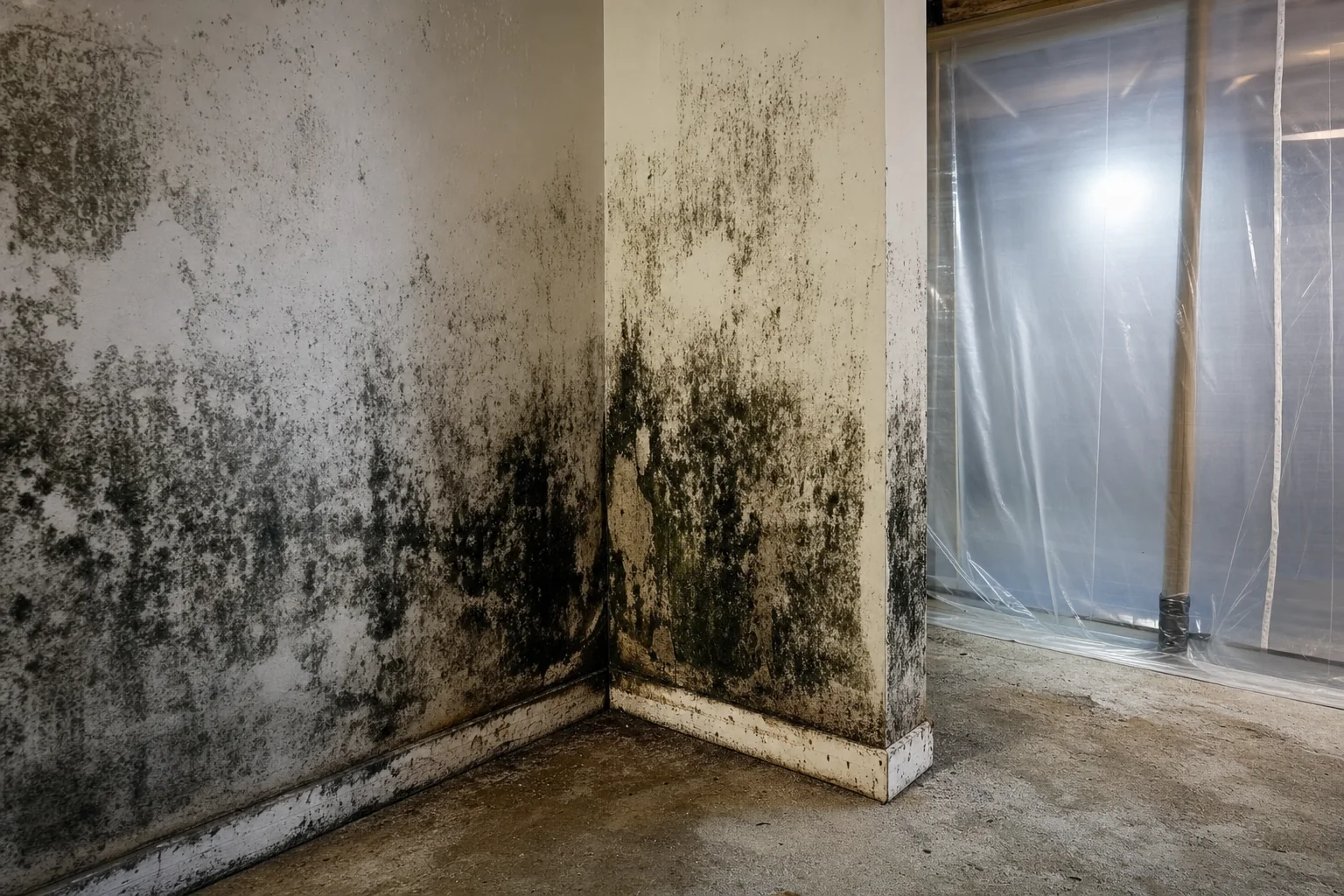
- Containment. We seal off the work area with plastic sheeting and establish negative air pressure using HEPA-filtered air scrubbers, so spores stay inside the containment zone and don't migrate to clean rooms during demolition.
- Air filtration. HEPA air scrubbers and exhaust systems capture airborne spores throughout the process, dramatically lowering the spore count in the air.
- Removal and cleaning. Contaminated porous materials are removed and bagged for disposal. Salvageable surfaces are HEPA-vacuumed, scrubbed, and treated with antimicrobial agents.
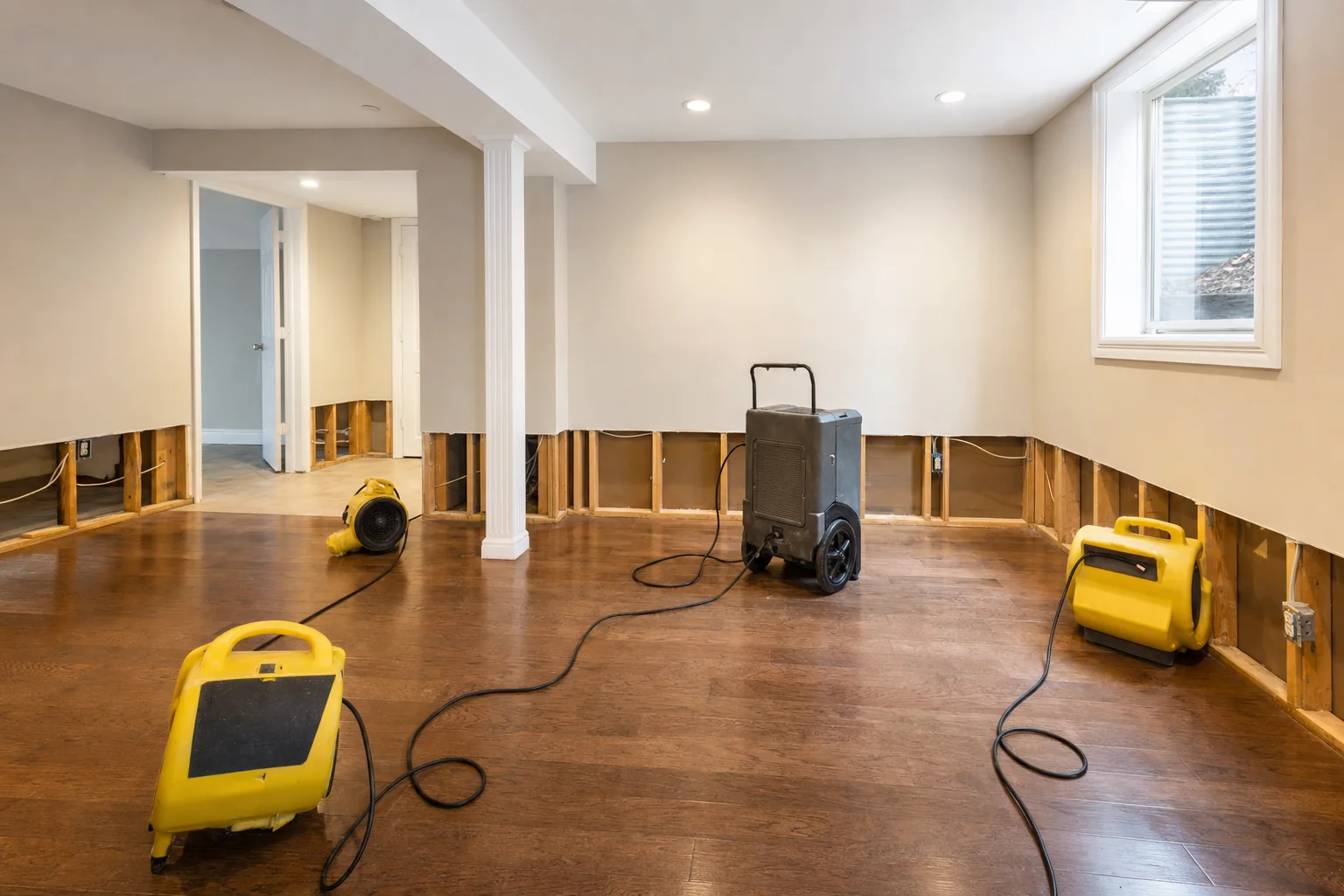
- Drying. We dry the structure completely with commercial dehumidifiers and air movers, typically over several days, because residual moisture invites the mold straight back.
- Disinfection and prevention. Surfaces are treated to inhibit regrowth, and we address the underlying moisture issue, whether that's a leak repair, improved ventilation, or a vapor barrier.
- Reconstruction. We rebuild what was removed, from drywall and paint to flooring and cabinetry, restoring the space to its pre-loss condition.
That last step is where being a full restoration and reconstruction contractor matters. Many "mold-only" outfits tear everything out and then hand you off to find a separate builder. Because AZA Restoration is a Class A licensed general contractor as well, we close the loop and put your home back together.
Do You Need a Permit for Mold-Related Repairs in Virginia?
Whether a permit is required depends on what gets rebuilt, not on the mold removal itself. Under the Virginia Uniform Statewide Building Code (USBC), straightforward like-for-like work such as replacing drywall, repainting, and surface drying is generally exempt and does not require a permit. However, once the project involves structural framing repairs, electrical, or plumbing work, a building permit is required from the relevant county or city building office, such as Fairfax County Land Development Services or the equivalent department in Loudoun, Prince William, or Arlington. AZA Restoration pulls the required permits and builds to code on every job that needs it, so you're never exposed to an unpermitted-work problem when you sell the home later. Homeowners in our Arlington County service area and across the region can rely on us to handle the local code requirements correctly.
Why You Shouldn't DIY Significant Black Mold Removal
Small surface mold on a non-porous bathroom surface, under about 10 square feet, is reasonable for a homeowner to clean with proper protection and ventilation. Beyond that, DIY usually does more harm than good. Here's why professional remediation is worth it once the problem grows:
- Disturbing mold without containment spreads spores. Scrubbing a large colony or tearing out drywall without negative air containment aerosolizes millions of spores, seeding new growth throughout the home.
- Bleach doesn't fix porous materials. The common myth that bleach "kills mold" overlooks that it can't reach the hyphae rooted inside drywall and wood. The visible surface looks clean while the colony survives underneath.
- You can't see the full extent. Without moisture meters and thermal imaging, homeowners consistently underestimate how far mold has traveled inside walls and floors.
- The moisture source goes unaddressed. If you don't fix the leak or humidity problem, the mold returns within weeks.
- Health exposure during removal. Disturbing a colony spikes airborne spore counts exactly when you're closest to it.
Mold almost always traces back to a water problem, so a thorough professional response also looks for the related damage. If your mold followed a leak or flood, our water-focused restoration work, detailed alongside our broader mold remediation services, addresses both the moisture and the growth together rather than treating one symptom at a time.
How Fast Should You Act, and What Does AZA Restoration Do?
Act immediately. Mold can begin growing on wet materials within 24 to 48 hours, and an established colony spreads continuously as long as moisture is present. Every day of delay means more affected square footage and a higher final bill. The good news is that catching it early often keeps a job in the affordable, single-day range.
When you call AZA Restoration, here's what happens: we arrive on-site within a guaranteed 90 minutes anywhere in Fairfax, Loudoun, Prince William, Stafford, Fauquier, and Arlington counties, plus Alexandria, Falls Church, Herndon, Manassas, and Manassas Park. We assess the full scope, identify and stop the moisture source, contain and remove the mold to industry restoration standards, dry the structure, and rebuild what's affected, all as one continuous project. As a fully insured contractor, we also bill your insurance directly where coverage applies, so you're not fronting the cost and chasing reimbursement.
Frequently Asked Questions
How much does black mold removal cost in Northern Virginia?
Black mold removal cost in Northern Virginia typically ranges from $500 to $6,000, with most contained jobs falling between $1,500 and $3,500. Small, localized problems sit at the low end, while widespread or hidden contamination involving HVAC systems or structural materials can exceed $10,000. The cost does not include reconstruction of removed materials, which is a separate phase. The biggest cost factor is the affected square footage and whether the mold has penetrated porous materials like drywall and insulation.
Is black mold actually dangerous to my health?
Black mold can cause allergy-like and respiratory symptoms, including congestion, coughing, throat and eye irritation, headaches, and worsening asthma. Healthy adults usually experience mild to moderate symptoms, while infants, older adults, people with asthma or allergies, and immunocompromised individuals face higher risk. Serious mycotoxin illness is uncommon, but any indoor mold is a health stressor that should be removed by addressing both the moisture source and the contaminated material.
Can I just clean black mold with bleach myself?
Bleach can clean small surface mold on non-porous materials like tile or glass, and a homeowner can reasonably handle under about 10 square feet with proper ventilation and protection. However, bleach cannot reach mold rooted inside porous materials like drywall and wood, so the colony survives beneath a clean-looking surface. Anything larger, hidden inside walls, or involving HVAC should be handled professionally with proper containment to avoid spreading spores throughout the home.
Does homeowners insurance cover black mold remediation?
Coverage depends on the cause. Most policies cover mold when it results from a sudden, covered water event, such as a burst pipe or appliance failure, but exclude mold caused by long-term neglect, ongoing leaks, or flooding without separate flood insurance. AZA Restoration is fully insured and bills insurance directly where coverage applies, and we document the cause and scope to support your claim. Call (571) 506-6668 and we'll help you understand your coverage situation.
How long does mold remediation take?
Most mold remediation projects take one to five days, depending on scope. A small, localized problem can be handled in a single day, a single room or contained area usually takes one to three days, and extensive or whole-home contamination can take five days or more. Structural drying adds several days, and any reconstruction of removed materials is an additional phase measured in days to a few weeks.
Will black mold come back after remediation?
Properly performed remediation prevents regrowth by removing the contaminated material and, critically, fixing the underlying moisture source that fed the mold in the first place. Mold returns only when moisture returns, which is why surface treatments and painting over mold fail. AZA Restoration traces and resolves the root moisture problem, whether it's a leak, foundation seepage, or chronic humidity, so the mold doesn't simply grow back.
Stop black mold before it spreads through your home. AZA Restoration provides 24/7 emergency mold remediation across Northern Virginia with a guaranteed 90-minute on-site arrival and direct insurance billing. Our Class A licensed, fully insured team finds the source, removes the mold to industry standards, and rebuilds what's affected, all under one roof. Call (571) 506-6668 today. One call rebuilds it all.