To file a water damage insurance claim in Virginia, take these steps in order: (1) stop the water source and document everything with photos and video before you touch anything, (2) call your insurance company to open a claim and write down your claim number, (3) make reasonable emergency repairs to prevent further damage and save all receipts, (4) bring in a licensed restoration contractor to mitigate and document the loss, (5) meet the adjuster and provide your evidence, and (6) review the settlement before you sign off. Done correctly, this sequence protects both your home and your payout. Done in the wrong order—or with gaps in your documentation—it is the single most common reason Northern Virginia homeowners end up underpaid or denied.
Water damage is the most frequent property insurance claim in the United States, and Virginia homeowners are no exception. Between aging plumbing in older Fairfax and Arlington homes, heavy summer storms across the Potomac and Occoquan watersheds, and the freeze-thaw cycles that crack pipes every winter, a burst line can flood a finished basement in minutes. This guide walks you through the process step by step, explains what Virginia policies typically cover, and shows how working with a restoration contractor early strengthens your claim.
What Does Homeowners Insurance Actually Cover for Water Damage in Virginia?
Standard Virginia homeowners policies (HO-3 and HO-5 forms) cover water damage that is sudden and accidental—a pipe that bursts, a supply line that fails, a water heater that ruptures, or an overflowing appliance. What they generally do not cover is damage from lack of maintenance, gradual unaddressed leaks, or surface flooding from outside. That last distinction trips up the most homeowners, so it is worth understanding before you file.
Covered vs. Not Covered: The Critical Distinction
Insurance companies draw a hard line between an internal plumbing failure and external flooding. A pipe bursting inside your wall is covered by homeowners insurance. Rising water from a creek, storm surge, or saturated ground entering your basement from outside is considered a flood, and flood damage is excluded from standard homeowners policies. Flood coverage requires a separate policy through the National Flood Insurance Program (NFIP) or a private flood insurer.
This matters enormously in Northern Virginia. Properties near Cameron Run in Alexandria, Difficult Run in Fairfax County, or the floodplains along the Occoquan and Potomac rivers carry real flood risk a standard policy will not touch. If your basement floods during a storm, the source of the water determines which policy responds. Our overview of water damage restoration explains how these scenarios differ in the field.
Common Water Damage Scenarios and How They're Classified
| Scenario | Typical Classification | Usual Coverage |
|---|---|---|
| Burst supply line under a sink | Sudden & accidental | Covered (homeowners) |
| Water heater rupture | Sudden & accidental | Covered (homeowners) |
| Roof leak from storm damage | Wind-driven rain | Usually covered if roof was intact |
| Sewer or drain backup | Backup | Covered only with a backup endorsement |
| Slow leak under a tub for months | Gradual/maintenance | Often denied |
| Creek or river overflow into basement | Flood | Needs separate flood policy |
Sewer and drain backups deserve special attention. A standard policy does not cover sewage backing up through floor drains unless you carry a specific water backup endorsement, which most insurers offer for a modest annual premium. Given how common basement backups are across older Northern Virginia neighborhoods, this endorsement is one of the smartest add-ons available.
Step 1: Stop the Water and Document Everything First
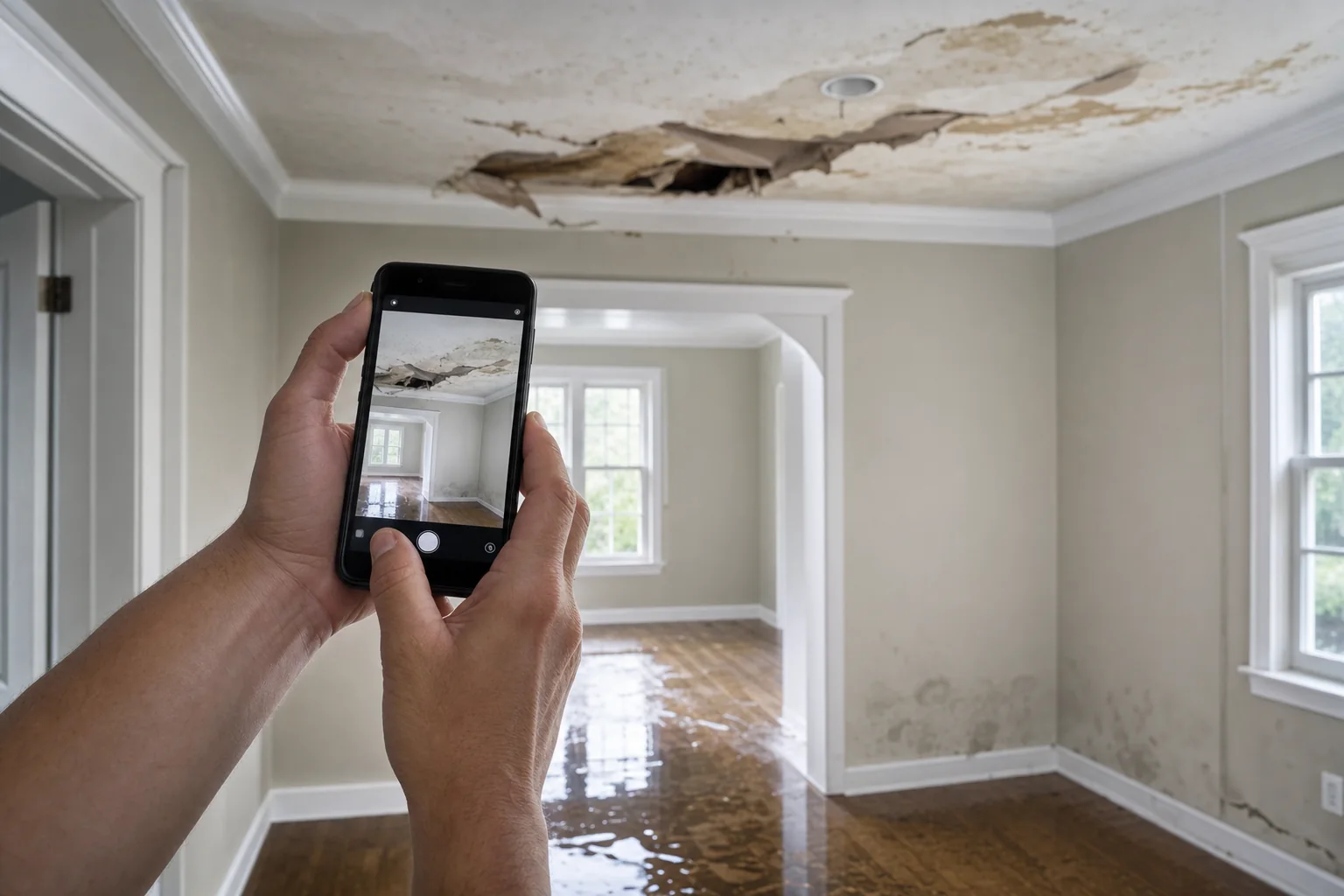
The very first thing to do is stop the flow of water—shut off the main supply valve or the fixture valve—and ensure everyone is safe. But before you start mopping or tearing up carpet, photograph and video everything. Documentation captured in the first hour is the single most valuable asset in your claim.
How to Document Water Damage for an Insurance Claim
- Photograph wide and close. Take wide shots of each affected room showing the full extent, then close-ups of damaged materials, standing water, and the source.
- Capture the source. Photograph the burst pipe, failed appliance, or leak point clearly—this proves the damage was sudden and accidental.
- Record video with narration. A slow walkthrough describing what happened and when is powerful supporting evidence with built-in timestamps.
- Inventory damaged belongings. List affected contents with approximate age and value; photograph serial numbers and model labels where possible.
- Do not throw anything away yet. Set damaged items aside until the adjuster has reviewed your claim.
Virginia policies impose a duty on the homeowner to mitigate further damage—to take reasonable steps, like shutting off the water and starting to dry the area, to keep a small loss from becoming a large one. Failing to mitigate can reduce your payout. This is where calling for emergency restoration early both satisfies your duty and protects your claim, because a professional response is documented, measured, and defensible.
Step 2: Call Your Insurance Company and Open the Claim
Once water is stopped and the scene is documented, contact your insurer's claims department to report the loss. Most carriers have 24/7 claims lines, and many prefer that you report promptly—Virginia policies typically require notice "as soon as practicable." When you call, be factual and brief: describe what happened, when you discovered it, and what you have done so far. Avoid speculating about cause or fault.
AZA Restoration answers 24/7 with a guaranteed 90-minute on-site response across Fairfax, Loudoun, Prince William, Stafford, Fauquier, and Arlington counties — plus Alexandria, Falls Church, Herndon, Manassas, and Manassas Park. We bill your insurance directly.
Call (571) 506-6668What Information You'll Need on the First Call
- Your policy number and contact information
- The date and approximate time the damage occurred or was discovered
- A short factual description of the cause (e.g., "supply line under the kitchen sink burst")
- The rooms and major items affected
- Any emergency steps you have already taken
Write down your claim number, the name of the representative, and the date and time of the call. Ask two questions specifically: what your deductible is for this loss, and whether your policy includes coverage for temporary housing (loss of use) if your home becomes uninhabitable. The insurer will assign an adjuster and explain next steps. Keep a simple log of every conversation from this point forward—dates, names, and what was discussed.
Should You File a Claim at All?
Not every water event warrants a claim. If the damage is minor and the repair cost is close to or below your deductible, filing may cost more in future premium increases than it returns. A reasonable rule: if the documented damage clearly exceeds your deductible by a meaningful margin, file. If it is borderline, have a restoration contractor scope the true extent—including hidden moisture behind walls and under flooring—before you commit to a claim that goes on your record.
Step 3: Make Emergency Repairs and Mitigate Damage
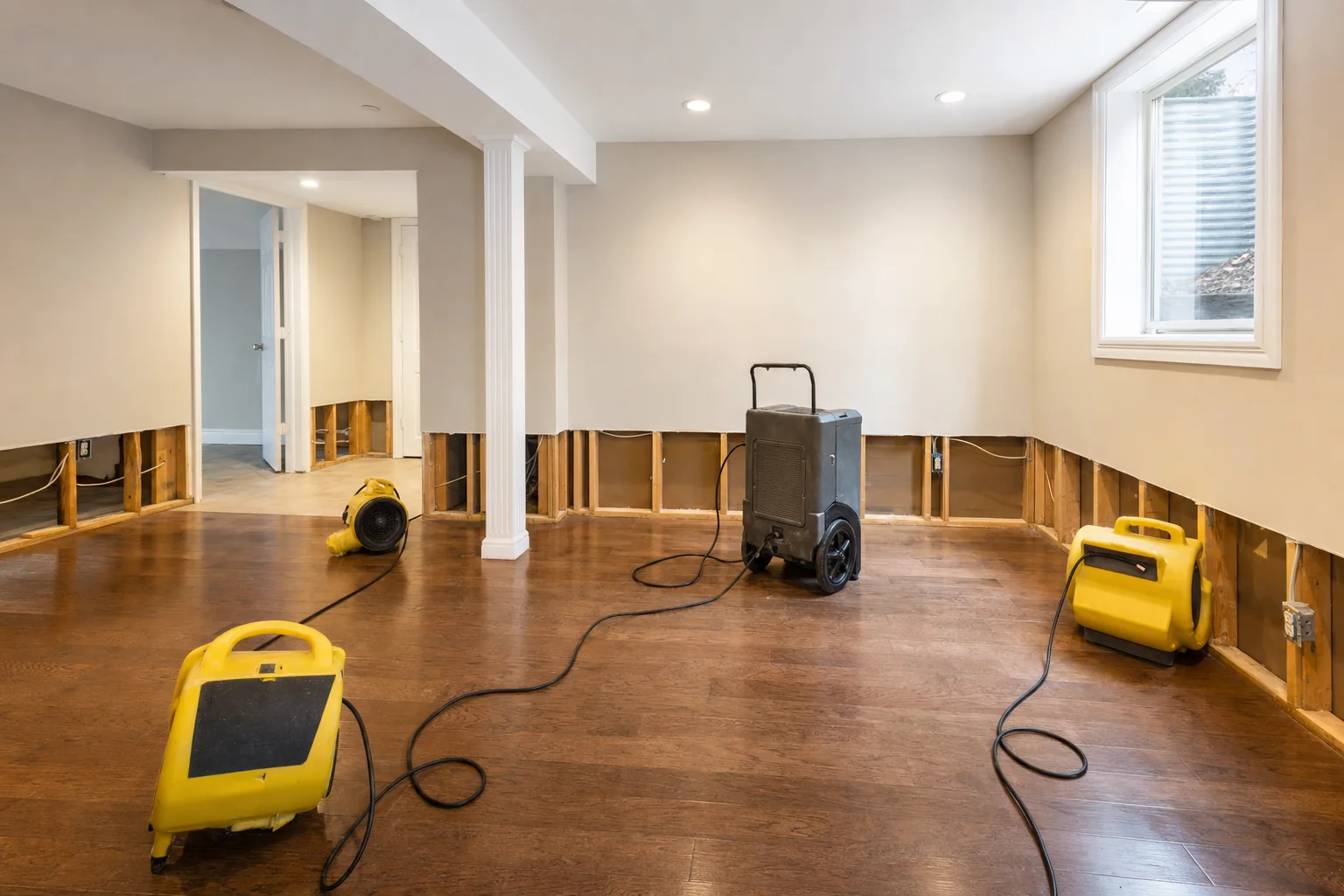
While your claim is opening, you are expected to prevent the situation from worsening. Reasonable temporary measures include extracting standing water, setting up fans and dehumidifiers, covering broken windows, and tarping a damaged roof. These are mitigation steps, not permanent repairs—and your policy generally reimburses reasonable mitigation costs.
Why Speed Matters: The Mold Clock Starts at 24-48 Hours
Mold can begin to grow on damp materials within 24 to 48 hours, and Northern Virginia's humid summers accelerate it dramatically. If wet drywall, carpet padding, and framing are not dried within that window, a covered water claim can spiral into a far more expensive mold remediation project—and insurers may argue that mold from delayed response is not their responsibility. Acting fast is both a health priority and a financial one. Professional structural drying typically takes 3 to 5 days when started promptly.
Need water out fast? AZA Restoration answers 24/7 and guarantees on-site arrival within 90 minutes across Northern Virginia, with direct insurance billing. Call (571) 506-6668 the moment you discover water damage.
Save Every Receipt
Keep receipts for everything: a wet-vac rental, fans, a tarp, a plumber's emergency visit, even towels and trash bags. Reasonable mitigation expenses are reimbursable, but only if you can document them. Hold onto removed materials until the adjuster confirms they can be discarded.
Step 4: Bring In a Licensed Restoration Contractor
You are not required to use a contractor your insurer recommends. In Virginia, you have the right to choose your own licensed restoration company—and there are real advantages to doing so. A Class A licensed and fully insured contractor works for you, documents the loss with moisture readings and thermal imaging, produces a detailed scope of work, and bills your insurer directly so you are not floating thousands of dollars out of pocket.
How a Restoration Contractor Strengthens Your Claim
An adjuster visits once and estimates from what they can see. A restoration contractor is on site for days, mapping moisture migration through walls and subfloors, photographing concealed damage as it is uncovered, and generating reports in the same estimating software (such as Xactimate) that insurers use. When your contractor's scope and the adjuster's estimate are written in the same language, settlements go faster and disputes shrink. This is the core value of professional insurance claims support—the loss is measured, not guessed.
Trained Specialists and Industry Restoration Standards
Proper water restoration follows established industry restoration standards for water categorization, drying, and verification. Water is classified by contamination level—clean (Category 1), gray (Category 2), and black (Category 3)—and the cleanup protocol changes accordingly. A burst supply line is Category 1; a sewage backup is Category 3 and requires handling. Trained restoration specialists know which materials can be dried and saved versus which must be removed, and they document that reasoning for the adjuster. AZA Restoration is a Class A licensed general contractor, so the same company that dries your home can also rebuild it—one accountable party from extraction through final reconstruction.
Step 5: Meet the Adjuster and Present Your Evidence
The adjuster's job is to inspect the damage, determine what your policy covers, and estimate repair cost. Be present for this visit if you can, and hand over your organized evidence: photos, video, your communication log, receipts, a contents inventory, and your contractor's moisture documentation and scope of work.
Public Adjuster vs. Company Adjuster: Know the Difference
The adjuster your insurer sends works for the insurance company. A public adjuster is an independent professional you can hire to represent your interests, typically for a percentage of the settlement. For well-documented water claims—especially when a reputable restoration contractor is producing detailed reports—a public adjuster is often unnecessary. For large or disputed losses, one may be worth considering. In Virginia, public adjusters must be licensed by the State Corporation Commission's Bureau of Insurance.
What to Do If Your Claim Is Underpaid or Denied
If you disagree with the adjuster's estimate, you have options. Most homeowners policies include an appraisal clause that lets you and the insurer each hire an appraiser to resolve disputes over the amount of loss. You can also request a written explanation of any denial and supplement your claim with additional documentation—which is exactly why thorough contractor records matter. If you believe your claim was handled in bad faith, the Virginia Bureau of Insurance investigates consumer complaints. A complete paper trail is your strongest leverage.
Step 6: Complete Repairs to Code and Close the Claim
Once your settlement is agreed, repairs and reconstruction begin—ranging from drywall and flooring replacement to full structural rebuilds, depending on severity. Here is where Virginia's building code becomes relevant.
Do You Need a Permit to Repair Water Damage in Virginia?
It depends on the scope. Like-for-like drying and surface repairs—replacing drywall, painting, swapping out the same flooring—are usually exempt from permitting. But structural, electrical, or plumbing rebuilds require a permit under the Virginia Uniform Statewide Building Code (USBC), issued by your local building office—for example, Fairfax County Land Development Services, or the equivalent department in Loudoun, Prince William, Stafford, Fauquier, or Arlington counties and in the cities of Alexandria, Falls Church, Manassas, and Manassas Park. A licensed general contractor pulls the required permits and builds to code, protecting your home's resale value and insurability. AZA Restoration handles permitting as part of full reconstruction so you do not have to navigate county offices yourself.
Typical Water Damage Costs and Timelines in Northern Virginia
Costs vary with the category of water, the materials affected, and how quickly drying began. These are typical market ranges, not quotes.
- Localized water damage (one room, clean water): roughly $1,200–$5,500. Structural drying 3–5 days.
- Major or whole-home water damage: roughly $8,000–$25,000+.
- Flood cleanup (separate flood policy): roughly $3,000–$15,000+, higher for Category 3 contaminated water. Cleanup and drying 5–10 days.
- Mold remediation (if drying was delayed): roughly $500–$6,000; widespread or hidden mold can exceed $10,000. Typically 1–5 days.
- Reconstruction: from about $10,000 for a single room to $100,000+ for a major rebuild.
Before the claim is officially closed, confirm that the settlement covers the full agreed scope, that any withheld depreciation (the difference between actual cash value and replacement cost) will be released once repairs are complete, and that you have documentation of all finished work.
The Northern Virginia Angle: Climate, Watersheds, and Local Risk
Where you live in the region shapes both your risk and your claim. Northern Virginia's mix of older housing stock, dense tree cover, clay-heavy soils, and a humid subtropical climate creates distinct water exposure.
Seasonal Patterns That Drive Claims
- Winter: Freeze-thaw cycles burst pipes in unconditioned spaces—crawlspaces, garages, and exterior walls. A single overnight freeze can flood a home by morning.
- Spring and summer: Intense thunderstorms and tropical systems overwhelm storm drains and saturate ground along the Potomac and Occoquan tributaries, driving basement intrusion and sump pump failures.
- Year-round: Aging supply lines and water heaters in mid-20th-century Fairfax and Arlington homes fail without warning.
Because the region sits across multiple watersheds, the homeowners-versus-flood coverage question comes up constantly here. A storm that pushes a nearby creek over its banks is a flood event; the same storm driving rain through a wind-damaged roof is a homeowners claim. Carrying the right coverage is half the battle, and our emergency restoration team can document the cause clearly so the correct policy responds.
Putting It All Together: Your Water Damage Claim Checklist
Here is the sequence to follow when water strikes:
- Stop the water source and ensure everyone is safe.
- Document everything with photos and video before cleanup.
- Call your insurer, open the claim, and record the claim number.
- Begin reasonable mitigation and save every receipt.
- Bring in a Class A licensed restoration contractor to dry and document.
- Meet the adjuster and present your organized evidence.
- Complete repairs to USBC code and confirm the full settlement before closing.
The homeowners who recover fastest and get paid fairly treat documentation as job one and bring in professionals early. A restoration contractor working alongside your adjuster is the difference between an estimate and a measured loss.
Water Damage? One Call Rebuilds It All.
AZA Restoration responds 24/7 with a guaranteed 90-minute on-site arrival across Fairfax, Loudoun, Prince William, Stafford, Fauquier, and Arlington counties, plus Alexandria, Falls Church, Herndon, Manassas, and Manassas Park. We extract, dry, document your loss for the insurer, bill your insurance directly, and rebuild to code—all under one Class A licensed, fully insured roof. Call (571) 506-6668 now and let our team handle the water and the paperwork, from the first photo to the final repair.
Frequently Asked Questions
How long do I have to file a water damage insurance claim in Virginia?
Virginia homeowners policies require you to report a loss "as soon as practicable," meaning promptly after you discover it. There is no single statutory deadline, but waiting can hurt you in two ways: insurers may argue that delay allowed avoidable damage like mold, and your duty to mitigate begins immediately. Report the claim within 24 to 48 hours of discovering water damage, and start documentation and drying right away.
Does homeowners insurance cover water damage from a burst pipe?
Yes. A burst pipe is the classic example of "sudden and accidental" water damage, which standard Virginia homeowners policies (HO-3 and HO-5) cover. The policy typically pays to dry the structure and repair the resulting damage, though it may not pay to replace the failed pipe itself. Damage from a slow, long-ignored leak is often denied as a maintenance issue, which is why prompt reporting and documentation matter.
Will filing a water damage claim raise my insurance premium?
It can. Insurers track water claims closely because they are frequent and costly, and multiple claims in a short period can raise premiums or affect renewal. For minor damage near or below your deductible, it may cost less long-term to pay out of pocket. For significant losses that clearly exceed your deductible, filing is usually the right financial decision. A restoration contractor can assess the true extent before you decide.
Can I choose my own restoration contractor, or must I use the insurance company's?
In Virginia, you have the right to choose your own licensed restoration contractor. Insurers may suggest companies from their preferred vendor program, but you are never obligated to use them. Choosing an independent Class A licensed contractor like AZA Restoration means your contractor works for your interests, documents the loss thoroughly, and bills the insurer directly while advocating for a complete, code-compliant repair.
What's the difference between water damage and flood damage for insurance?
Water damage from an internal source—a burst pipe, failed appliance, or water heater—is covered by standard homeowners insurance. Flood damage, defined as surface water entering from outside (rising creeks, storm surge, saturated ground), is excluded and requires a separate flood policy through the NFIP or a private insurer. In Northern Virginia's watershed-heavy terrain, the source of the water determines which policy responds, so identifying the cause correctly is essential.
Does insurance cover mold caused by water damage?
It depends on the cause and timing. If mold results directly from a covered, promptly addressed water loss, many policies cover remediation, sometimes up to a sublimit. If mold developed because the homeowner delayed response or ignored a leak, insurers often deny that portion. This is why drying must begin within the 24-to-48-hour window—fast professional mitigation both protects your health and preserves your coverage.