Yes, you usually need a permit to repair fire damage in Fairfax County whenever the work touches structure, electrical, plumbing, mechanical, or gas systems — but you typically do not need one for like-for-like cosmetic and surface repairs such as replacing drywall, painting, or drying out water-damaged finishes. The deciding factor is not whether damage was caused by water or fire; it is the scope of the repair. If a restoration project rebuilds load-bearing framing, rewires a burned circuit, opens up plumbing, or alters the footprint of a room, Fairfax County requires a building permit issued under the Virginia Uniform Statewide Building Code (USBC). If the project simply restores finishes to their prior condition, it is generally exempt.
For homeowners in the middle of a stressful loss, that distinction matters. Permits protect you: they trigger inspections that confirm the rebuild is safe, they keep your insurance claim clean, and they prevent problems when you sell the home. Below, we explain when a permit is required, who pulls it, how the Fairfax County process works, what it costs, and how the answer differs between water and fire damage. As a Class A licensed restoration and general contractor based in Chantilly, AZA Restoration pulls the required permits and builds every repair to code — one call rebuilds it all.
Do you need a permit to repair water or fire damage in Fairfax County?
The short answer: it depends on what you are repairing, not what caused the damage. Fairfax County, like every Virginia jurisdiction, enforces the Virginia Uniform Statewide Building Code (USBC), which is based on the International Residential Code and International Building Code. The USBC defines which work is "ordinary repair" (exempt from permitting) and which work constitutes alteration, reconstruction, or new construction (permit required).
In practical terms, restoration work falls into two buckets:
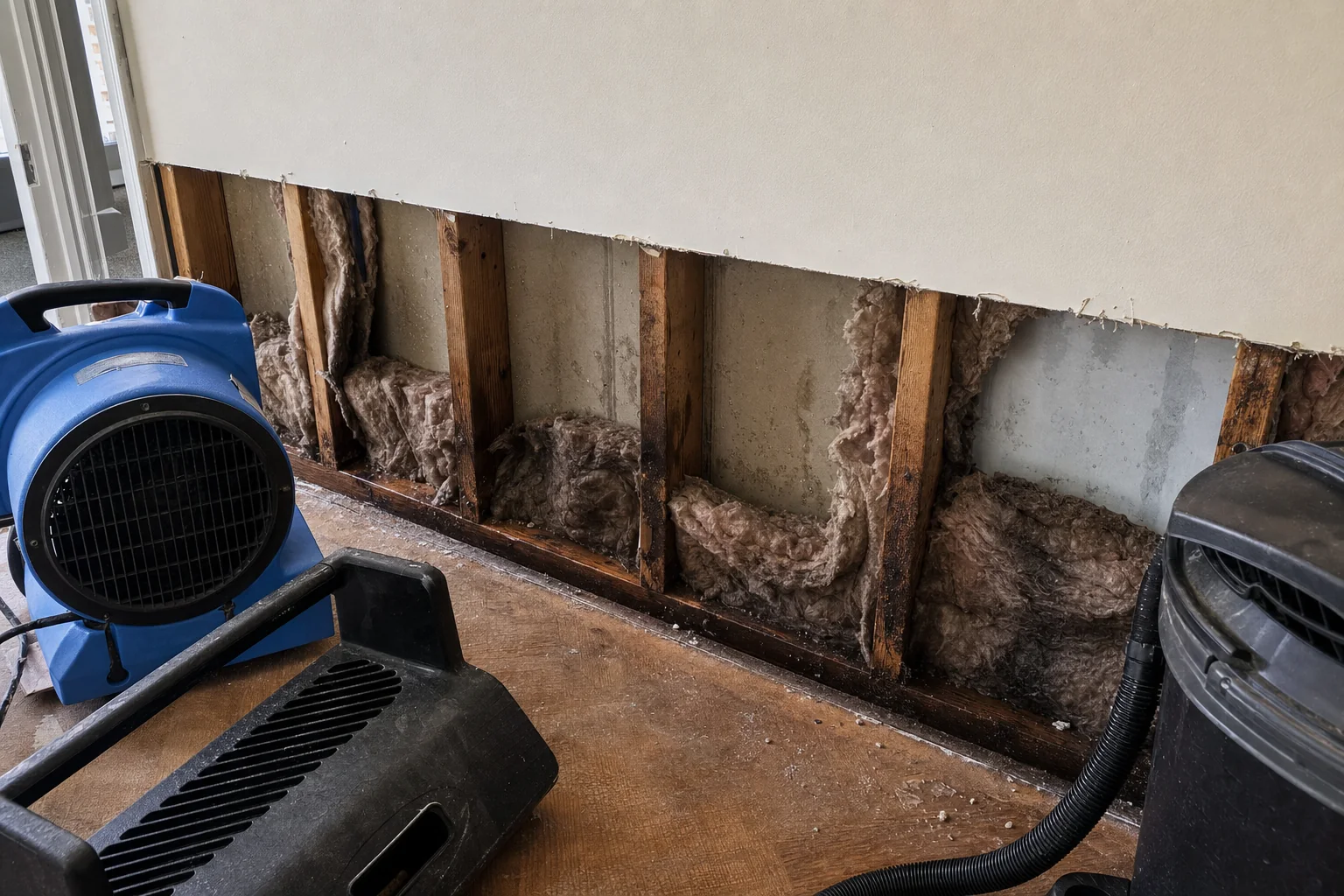
- Permit usually NOT required — ordinary repairs and like-for-like replacement: Removing and replacing wet drywall with the same material, repainting, replacing trim and baseboards, swapping out flooring or carpet, replacing a vanity or cabinet in the same location, and structural drying or dehumidification. These restore the home to its pre-loss condition without changing the structure or systems.
- Permit USUALLY required — structural, electrical, plumbing, mechanical, and gas work: Replacing or sistering damaged floor joists, rafters, or studs; rebuilding a burned wall or roof section; rewiring scorched circuits or replacing a damaged electrical panel; relocating or replacing plumbing supply and drain lines; replacing an HVAC system or ductwork; and any work that changes the layout, adds square footage, or affects fire-rated assemblies.
Because fire damage so often reaches framing, wiring, and mechanical systems, fire repairs cross the permit threshold far more frequently than water repairs do. But a major water loss — one that warps subfloor, delaminates structural sheathing, or requires opening walls to replace plumbing — absolutely triggers permits too. The cause is incidental; the scope governs.
Why the permit question matters more than homeowners expect
It is tempting, in the rush to make a damaged home livable again, to skip the paperwork. Don't. Unpermitted structural or electrical work in Fairfax County creates three serious risks. First, safety: inspections verify that framing carries load, wiring is correctly sized and grounded, and gas connections are leak-free — and after a fire, hidden char to concealed framing is common, so only an inspection confirms the rebuild is sound. Second, insurance: carriers can deny or claw back payments if a rebuild was done without required permits, and final payment often hinges on a passed inspection. Third, resale: unpermitted work surfaces during a home sale, and buyers, lenders, and county records will flag it — sometimes forcing expensive retroactive permitting and tear-out years later.
Who is responsible for pulling the permit — you or your contractor?
In Fairfax County, the contractor performing the work is normally the party that applies for and holds the permit, and that is exactly how it should be. A licensed contractor is accountable to the building code, schedules and meets the inspectors, and warrants that the finished work passes. When you hire a Class A licensed restoration and general contractor, permitting is part of the job — not a task left on your plate during an already difficult time.
Homeowners can pull their own permits for work on a home they own and occupy, but for fire and major water restoration this is rarely wise. You would assume direct responsibility for code compliance, scheduling inspections, any required corrections, and personal liability if the work later proves deficient. For anything beyond basic cosmetic repair, having your restoration contractor handle the permit protects you and keeps the insurance claim straightforward.
At AZA Restoration, our team manages the entire permitting workflow as part of full reconstruction services: we determine whether a permit is required, prepare the application and any drawings, submit to the relevant building office, coordinate every inspection, and build to current code. Because we are both a restoration company and a general contractor, the same crew that mitigates the damage also rebuilds it — no handoffs, no gaps, no surprises.
Not sure whether your repair needs a permit? Call AZA Restoration at (571) 506-6668 for a free, no-pressure assessment. We respond on-site across Northern Virginia within 90 minutes, pull every required permit, and bill your insurance directly.
What work triggers a permit under the Virginia USBC?
The Virginia Uniform Statewide Building Code is the single statewide standard that Fairfax County enforces through its building office. While the code's language is technical, the practical triggers for restoration projects are consistent. The table below summarizes the most common scenarios our crews encounter.
| Restoration work | Permit typically required? | Why |
|---|---|---|
| Replacing wet or smoke-stained drywall (like-for-like) | No | Ordinary repair; no structural or system change |
| Repainting, new trim, new flooring, carpet | No | Cosmetic finish work |
| Structural drying and dehumidification | No | Mitigation, not construction |
| Replacing or sistering joists, studs, rafters, beams | Yes | Structural alteration affecting load path |
| Rebuilding a burned wall, ceiling, or roof section | Yes | Structural reconstruction |
| Rewiring circuits, replacing electrical panel | Yes (electrical permit) | Life-safety electrical work |
| Replacing or relocating plumbing supply/drain lines | Yes (plumbing permit) | Concealed system work |
| Replacing HVAC equipment, furnace, or ductwork | Yes (mechanical permit) | Mechanical system work |
| Repairing/reconnecting gas appliances or lines | Yes (gas/mechanical permit) | Gas safety |
| Changing room layout or adding square footage | Yes (building permit) | Alteration of structure and use |
A useful rule of thumb: if the repair stays on the surface, it is usually exempt; if it goes behind the wall, into the framing, or into a system, expect a permit. After a fire, even when the visible damage seems limited, heat and smoke often compromise concealed wiring and framing, which is why fire reconstruction so reliably requires permits and inspections. Our fire damage restoration crews assess concealed damage before scoping the rebuild, so the permit application reflects the true extent of work.
Emergency mitigation does not wait for a permit
Immediately after a loss, life-safety mitigation can and should begin right away — you do not wait on a permit to make the property safe and stop further damage. Water extraction, structural drying, emergency board-up, and roof tarping are mitigation activities, not construction, and they are appropriate before any permit is issued. The permit comes into play at the reconstruction phase, when permanent structural, electrical, plumbing, or mechanical repairs begin. This staged approach — stabilize first, rebuild to code second — is standard practice and exactly how our teams operate.
How does the Fairfax County permit process work?
Fairfax County administers building permits through its building office (Land Development Services / the Department of Land Development Services), which reviews applications, issues permits, and conducts inspections to verify USBC compliance. For most restoration reconstruction projects, the workflow looks like this:
- Scope and document the damage. The contractor determines the full extent of structural and system damage, including concealed areas, and defines what must be rebuilt versus restored.
- Determine which permits apply. A single project may need a combination of building, electrical, plumbing, mechanical, and gas permits depending on what was affected.
- Prepare and submit the application. The contractor files with the county building office, including drawings or a scope of work where required.
- Plan review and issuance. The county reviews for code compliance. Straightforward like-for-like reconstruction is reviewed quickly; projects that alter structure or layout take longer.
- Build and call for inspections. Work proceeds in stages, with inspections at key points — for example, rough-in inspections for framing, electrical, and plumbing before walls are closed, then a final inspection.
- Final inspection and close-out. Once the work passes final inspection, the permit is closed. This passed final is frequently what an insurance carrier wants to see before releasing final payment.
The critical detail homeowners miss is the rough-in inspection: inspectors must see framing, wiring, and plumbing before they are covered with insulation and drywall. Closing up walls prematurely means tearing them back open. A seasoned contractor sequences the rebuild around these inspection points so the project flows without rework.
Permit costs and timelines for water and fire restoration
Permit fees in Fairfax County are modest relative to the overall cost of a restoration project — they are typically a small percentage of construction value and rarely the deciding factor in a rebuild budget. What drives cost and schedule is the scope of the reconstruction itself. The ranges below are typical market figures for Northern Virginia restoration work; your actual project depends on the size of the loss, materials, and how much of the structure and its systems must be rebuilt.
| Project type | Typical cost range | Typical timeline | Permit usually needed? |
|---|---|---|---|
| Localized water damage (one room/area) | $1,200 – $5,500 | 3 – 5 days structural drying | Often no (surface repairs) |
| Major / whole-home water damage | $8,000 – $25,000+ | Days to dry; weeks to rebuild | Often yes (structural/plumbing) |
| Flood cleanup and dry-out | $3,000 – $15,000+ | 5 – 10 days | Yes if structure affected |
| Mold remediation | $500 – $6,000 ($10,000+ if widespread) | 1 – 5 days | Usually no (unless rebuild) |
| Fire — soot/smoke cleanup | From ~$3,000 | Days | Often no for cleaning alone |
| Fire — full reconstruction | Up to $50,000+ | Weeks | Yes (structural/electrical) |
| Smoke and odor treatment | $2,000 – $15,000 | Days | Usually no |
| Full reconstruction (room to major rebuild) | $10,000 (single room) – $100,000+ | Weeks to months | Yes |
Notice the pattern: the cleanup and mitigation phases — extraction, drying, soot removal, deodorization — rarely require permits, while the reconstruction phase routinely does. Budgeting for a damaged home means planning for both the immediate mitigation and the permitted rebuild that follows.
Does pulling a permit slow down my restoration?
For most like-for-like reconstruction, permitting adds little time when an experienced contractor handles it — the application and review for straightforward repairs move quickly, and inspections are scheduled to align with the construction sequence. Where timelines stretch is on larger projects that alter structure or layout, which require more detailed plan review. The biggest avoidable delay is unpermitted work that gets discovered: that can halt a project, trigger fines, and force tear-out. Doing it right the first time is almost always faster than doing it twice.
Water damage vs. fire damage: how the permit answer differs
Although the permit rule is the same for both — scope, not cause — water and fire losses tend to land on opposite sides of the threshold in characteristic ways.
Water damage repairs and permits
Most residential water losses in Northern Virginia — a burst supply line, a failed water heater, an overflowing appliance, a roof leak — are resolved with mitigation and surface repair: extract the water, dry the structure, replace wet drywall and flooring, repaint. That work is generally permit-exempt. Permits enter the picture when water damage becomes structural or reaches concealed systems: rotted subfloor and sheathing, compromised framing, or opening walls to replace failed plumbing. Category 3 "black water" events — sewage backups and certain floods — often require rebuilding affected assemblies, pushing the project into permit territory.
Fire damage repairs and permits
Fire is far more likely to require permits because heat damage so often reaches the bones of the house. Soot and smoke cleaning on its own is typically non-permitted. But a fire that burns through drywall almost always damages the wiring, framing, and sometimes plumbing behind it, and the resulting reconstruction — rebuilding walls, replacing scorched circuits, restoring fire-rated assemblies — requires building and electrical permits and inspections. Heat also damages materials invisibly, so what looks like a surface scorch can conceal structural compromise. This is why we scope fire jobs conservatively and pull permits whenever the rebuild touches structure or systems.
The Northern Virginia angle: local code, climate, and why it matters
Fairfax County sits in a region with real exposure to water-driven damage, and that shapes how projects are scoped and permitted. The county's terrain drains toward the Potomac River and a web of tributaries — including the Difficult Run, Accotink, and Pohick watersheds — and heavy rain, the remnants of tropical systems, and rapid snowmelt regularly drive basement flooding, sump-pump failures, and stormwater intrusion. Aging housing stock in established neighborhoods adds older plumbing and wiring to the mix, so a "simple" water loss can uncover conditions that require code-compliant upgrades during the rebuild.
Every jurisdiction in the region enforces the same statewide code — the USBC — but each county and city runs its own building office, fee schedule, and inspection scheduling. Fairfax County issues permits through its building office; neighboring jurisdictions handle their own. Whether your property is in Fairfax County or elsewhere across our service area, the underlying rules are consistent, but knowing each office's process saves time. AZA Restoration works throughout Fairfax County and the surrounding region — Loudoun, Prince William, Stafford, Fauquier, and Arlington counties, plus Alexandria, Falls Church, Herndon, Manassas, and Manassas Park — and we know how each building office operates.
Building to code, not just back to "before"
A subtle but important point: code-compliant reconstruction sometimes means the rebuild must meet current standards, not simply replicate what existed. When a permitted project opens up walls in an older home, the work that is replaced generally must be brought up to today's code — for example, current requirements for electrical circuits, GFCI/AFCI protection, smoke and carbon-monoxide detection, or insulation. That is a benefit, not a burden: your repaired home ends up safer than it was before the loss. A Class A licensed general contractor anticipates these requirements at the scoping stage so there are no mid-project surprises.
Repair vs. replace: making the smart call after damage
One of the most consequential decisions after a loss is whether to repair an affected assembly or replace it — and that choice often determines whether you need a permit at all. The guidance below reflects how our crews think through it.
- Repair (often permit-exempt) when: damage is limited to finishes and surfaces; drywall, paint, trim, and flooring can be restored like-for-like; framing and systems are sound; moisture is fully removed and verified.
- Replace and rebuild (usually permit-required) when: framing is charred, rotted, or structurally compromised; wiring or plumbing in the affected area is damaged; mold has penetrated structural materials; or bringing the area to current code requires opening and reconstructing assemblies.
Replacing damaged structure costs more up front, but "repairing around" compromised framing or wiring is a false economy that fails inspection, voids warranties, and can endanger the household. The right answer comes from an honest assessment of concealed conditions before any rebuild begins. Our reconstruction team documents the full scope so the repair-versus-replace decision is based on evidence, not guesswork, and the permit application matches reality.
How AZA Restoration handles permits and rebuilds for you
Because AZA Restoration is both a restoration company and a Class A licensed general contractor, we carry a project from the first emergency call all the way through a permitted, inspected, code-compliant rebuild. Our process is built to remove the permitting burden from worried homeowners:
- Rapid response and mitigation. We arrive on-site within 90 minutes anywhere in Northern Virginia, 24/7, to stabilize the property — extraction, drying, board-up, and tarping — before any permit is needed.
- Full damage assessment. Our trained restoration specialists document visible and concealed damage so the scope is accurate and the permit application is complete.
- Permit determination and filing. We identify every required permit, prepare the application, and submit to the appropriate county or city building office.
- Code-compliant reconstruction. We rebuild to current code and coordinate all rough-in and final inspections so nothing gets closed up prematurely.
- Direct insurance billing. We document the loss for your carrier and bill insurance directly, and we know that a passed final inspection often unlocks final claim payment.
From a single damaged room to a major fire or flood rebuild, the same accountable team handles mitigation, permitting, and reconstruction — continuity that keeps your project safe, code-compliant, and on schedule.
Facing water or fire damage in Fairfax County or anywhere in Northern Virginia? Call AZA Restoration now at (571) 506-6668. We respond on-site within 90 minutes, pull every required permit, build to code, and bill your insurance directly. One call rebuilds it all.
Frequently Asked Questions
Do I need a permit to repair fire damage in Fairfax County?
Usually yes, if the repair involves structural framing, electrical wiring, plumbing, mechanical systems, or gas connections — which fire damage commonly affects. Fairfax County requires a building permit (and often separate electrical, plumbing, or mechanical permits) under the Virginia Uniform Statewide Building Code for this kind of reconstruction. Pure soot and smoke cleaning with no structural or system repair generally does not require a permit. Because fire and heat frequently damage concealed wiring and framing, most fire reconstruction projects do require permits and inspections.
Does water damage repair require a permit?
Not for most jobs. Like-for-like repairs — extracting water, drying the structure, and replacing wet drywall, flooring, paint, and trim — are considered ordinary repairs and are typically exempt. A permit is required when water damage becomes structural (compromised joists, subfloor, or sheathing) or when walls must be opened to replace damaged plumbing or wiring. Category 3 sewage and certain flood losses that require rebuilding affected assemblies also generally need permits.
Who pulls the permit, me or the restoration contractor?
For fire and major water restoration, your contractor should pull and hold the permit. A Class A licensed general contractor is accountable to the code, schedules and meets inspectors, and warrants that the work passes. Homeowners may pull their own permits on a home they own and occupy, but doing so transfers full responsibility for code compliance and inspections to you. AZA Restoration manages the entire permitting process as part of our reconstruction service.
How long does the Fairfax County permit process add to a rebuild?
For straightforward like-for-like reconstruction, an experienced contractor can keep permitting from adding meaningful delay — the review is quick and inspections are scheduled to match the build sequence. Larger projects that alter structure or layout require more detailed plan review and take longer. The most costly delays come from unpermitted work being discovered, which can stop a project and force tear-out, so permitting properly is usually faster overall.
What happens if fire or water repairs are done without a required permit?
Unpermitted structural, electrical, or plumbing work creates three problems: safety risks from work that was never inspected, potential denial or clawback of insurance claim payments, and complications when you sell the home, since unpermitted work is flagged in county records and during inspections. Correcting it later often means retroactive permitting and opening up finished walls. It is far less expensive to permit the work correctly the first time.
Will my insurance cover permitted reconstruction after a loss?
Covered losses typically include the cost of code-compliant reconstruction, and many policies include "ordinance or law" coverage that helps pay for code-required upgrades triggered when walls are opened during a permitted rebuild. Carriers generally expect required permits to be pulled and a final inspection to pass before releasing final payment. AZA Restoration documents the loss for your insurer and bills your insurance directly, so the permitting and claim stay aligned.