Crawl space mold in Northern Virginia almost always traces back to one root cause: chronic moisture. When relative humidity under your home stays above roughly 60 percent for long stretches, mold spores already present in the air find the wood, insulation, and soil they need to colonize. In our humid Mid-Atlantic climate, an untreated crawl space grows visible mold within weeks, and typical professional remediation falls in the $500 to $6,000 range, with widespread or structurally involved jobs sometimes exceeding $10,000. The good news for homeowners across Fairfax, Loudoun, Prince William, and surrounding counties is that crawl space mold is both preventable and fully fixable when you understand what drives it and act before it spreads into your living space.
This guide covers why crawl spaces in our region are so prone to moisture and mold, the warning signs, what removal and prevention involve, what it costs, and when to call a licensed restoration contractor. After years crawling under Northern Virginia homes, we find the patterns remarkably consistent. Once you know what to look for, you can stay ahead of the problem.
Why are Northern Virginia crawl spaces so prone to mold?
Northern Virginia sits in a humid subtropical climate zone with hot, wet summers and winter freeze-thaw cycles. The region drains into the Potomac and Occoquan watersheds, and large stretches of Fairfax, Loudoun, and Prince William counties are built on clay-heavy soils that hold water rather than letting it drain. A crawl space is essentially a shallow basement with a dirt or thin-slab floor, sitting directly against that moist soil. Without proper control, water vapor rises continuously from the ground into the enclosed space below your floor joists.
Mold is a living organism, and like any organism it needs specific conditions to grow. For a fuller primer on the biology, see our explainer on what mold is and how it spreads. In short, mold needs four things, and a neglected crawl space supplies all four.
- Moisture. This is the only one of the four you can realistically control. Remove the moisture and growth stops.
- An organic food source. Wood joists, subfloor, paper-faced insulation, and cardboard storage boxes are ideal.
- Moderate temperature. Crawl spaces stay in the comfortable 40 to 100 degree range mold prefers nearly year round.
- Mold spores. These are everywhere in outdoor and indoor air and cannot be eliminated, only deprived of moisture.
Because three of those four conditions are permanent fixtures of a Virginia crawl space, moisture control is the entire ballgame. It is why two identical homes on the same street can differ so much: the dry one has a working vapor barrier and good drainage, and the moldy one does not.
The stack effect: how crawl space air becomes the air you breathe
Many homeowners assume that whatever happens in the crawl space stays there. It does not. Warm air rises through a house and escapes through the upper levels, pulling replacement air upward from the lowest point of the home. Building scientists call this the stack effect, and a significant share of the air on your first floor originated in the crawl space below it. That means crawl space moisture, musty odor, and mold spores are continuously drawn into your living areas, where they can affect indoor air quality and aggravate allergies and asthma.
What are the warning signs of crawl space moisture and mold?
You do not have to crawl under your house to suspect a problem. Many of the earliest signals show up in your living space. Watch for the following, listed roughly in the order homeowners tend to notice them.
- A persistent musty or earthy odor on the first floor, often strongest near floor vents or on humid days.
- Cupping, buckling, or springy hardwood floors, caused by the subfloor absorbing moisture from below.
- Higher-than-normal indoor humidity that your HVAC system struggles to control in summer.
- Increased allergy, asthma, or respiratory symptoms that ease when you leave the house.
- Condensation or rust on ductwork, pipes, or metal supports in the crawl space.
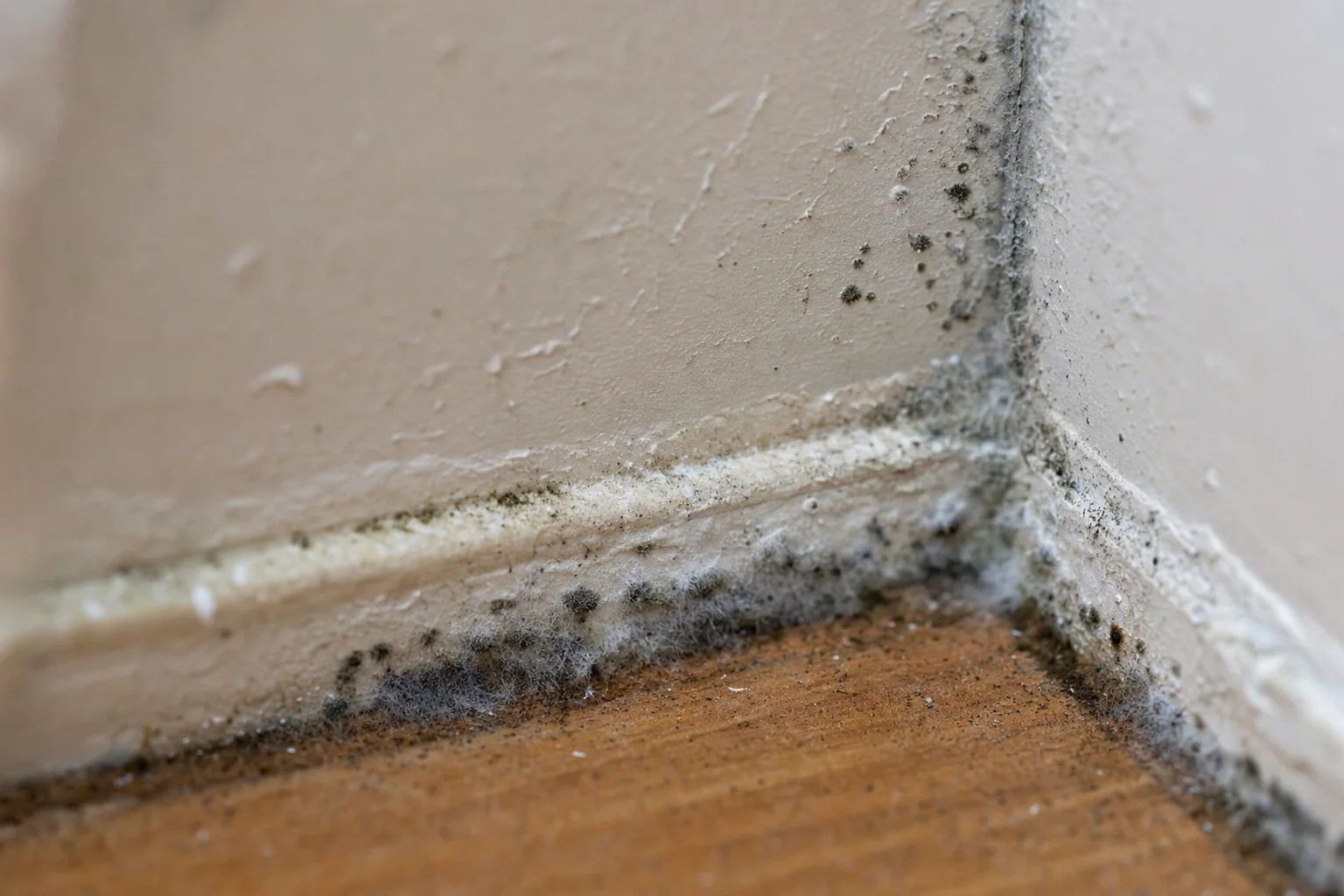
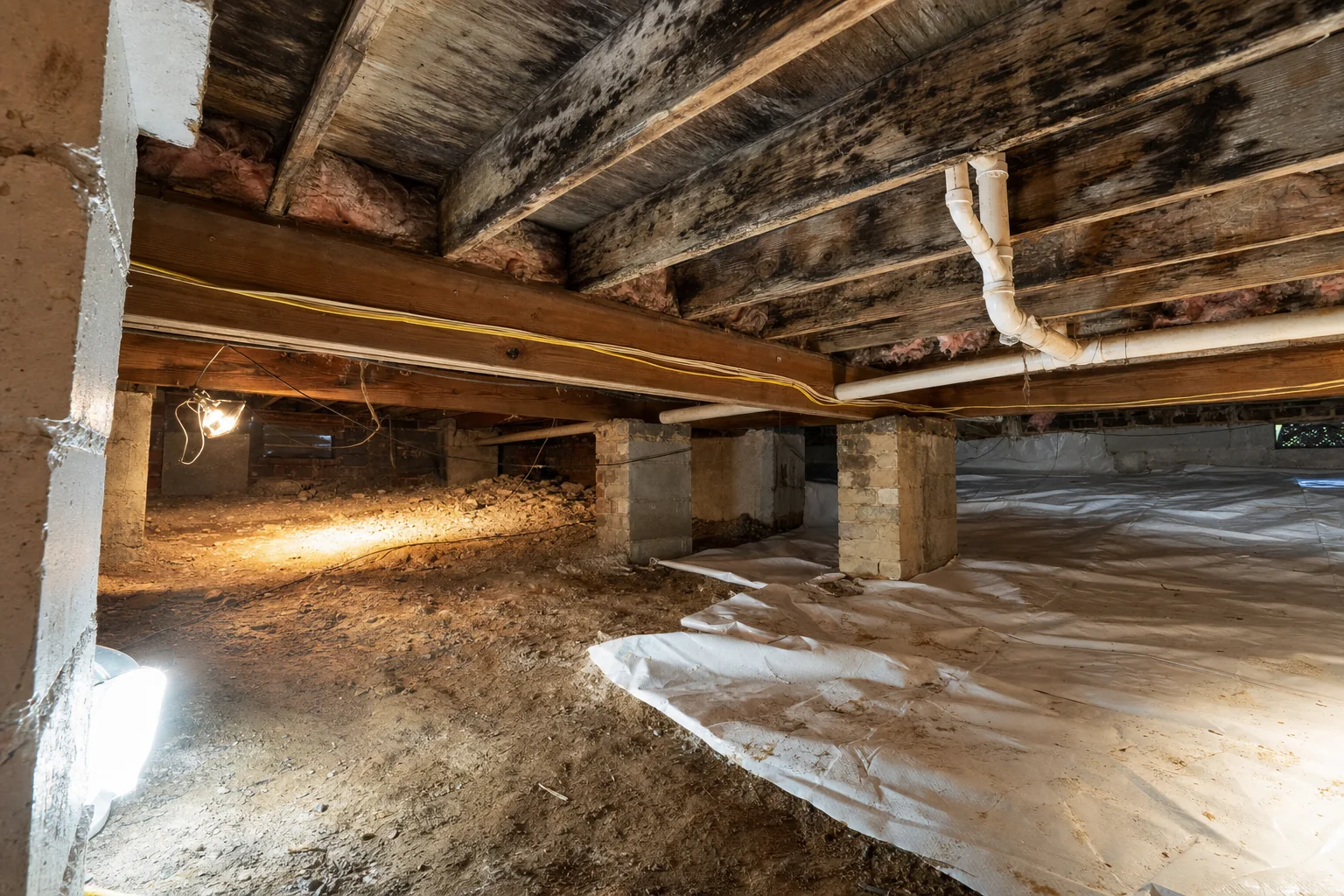
- Visible white, green, gray, or black fuzzy growth on joists, the subfloor, or insulation.
- Sagging or fallen insulation that has absorbed enough moisture to lose its grip on the joists.
- Pest activity, since the same damp conditions that feed mold also attract termites and rodents.
If you go down to look, bring a flashlight. Black staining on wood is not always active mold, and not all mold is the toxic black mold homeowners fear, but any growth combined with a damp surface warrants attention. To understand how growth turns into structural damage over time, see our overview of how mold damage develops in a home.
Surface mold versus a structural problem
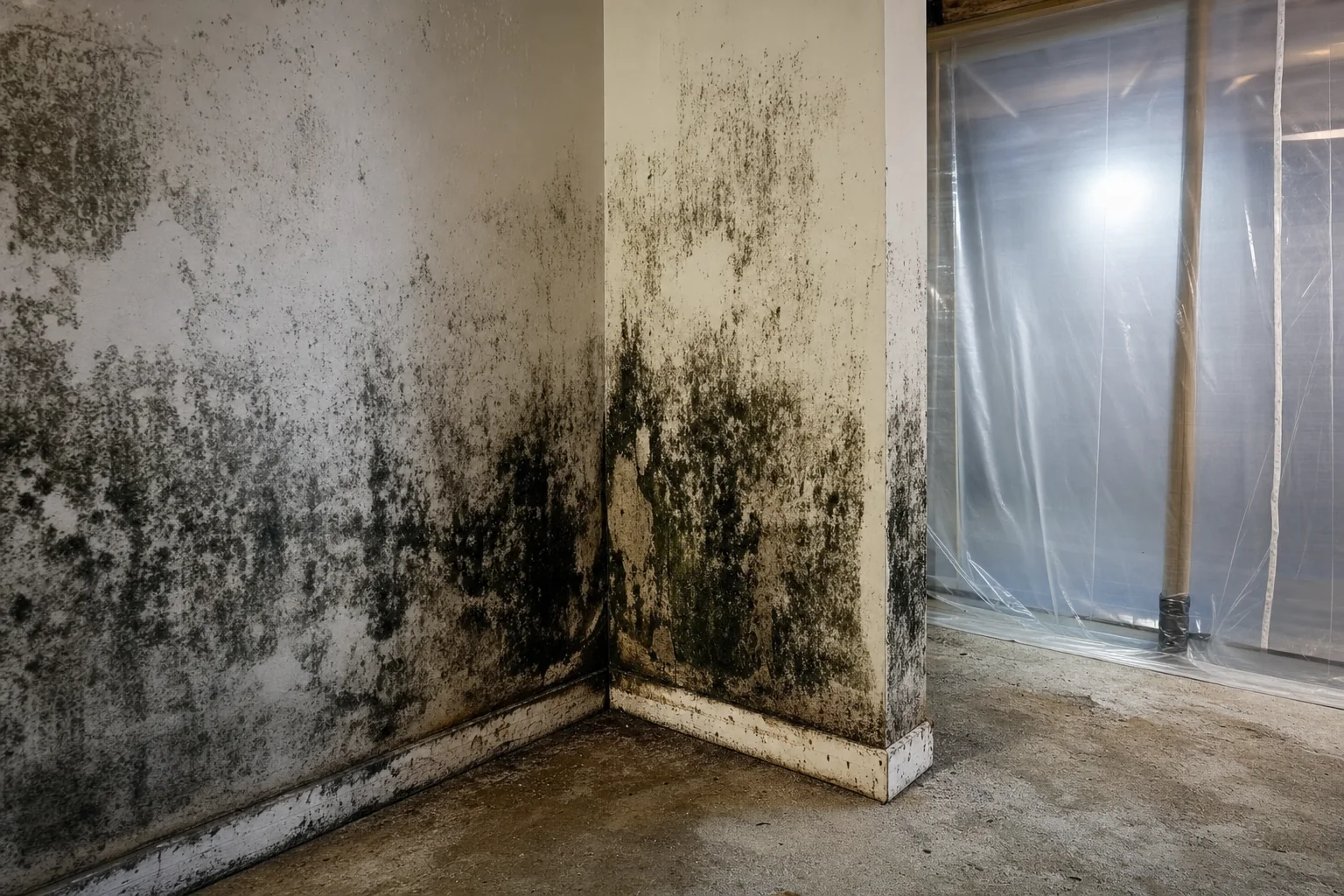
There is a meaningful difference between a light surface bloom on a single joist and a colonized crawl space involving insulation, multiple joists, and the subfloor. A small surface area caught early is often manageable. But once growth has penetrated the wood or spread across more than about ten square feet, you are facing a remediation project rather than a cleaning task, and the wood may need treatment or, in advanced cases, replacement.
What causes moisture in a crawl space?
Effective remediation always starts with finding and stopping the water source. If you remove mold without correcting the moisture, it will return within months. In Northern Virginia homes, crawl space moisture comes from a handful of recurring sources.
AZA Restoration answers 24/7 with a guaranteed 90-minute on-site response across Fairfax, Loudoun, Prince William, Stafford, Fauquier, and Arlington counties — plus Alexandria, Falls Church, Herndon, Manassas, and Manassas Park. We bill your insurance directly.
Call (571) 506-6668Ground moisture and missing or failed vapor barriers
The most common source is water vapor evaporating from bare soil. A crawl space floor without a sealed vapor barrier can release several gallons of water into the air every day. Many older homes around Falls Church, Herndon, and Manassas were built with thin plastic sheeting that has since torn, shifted, or was never sealed at the seams and walls.
Poor exterior drainage and grading
When soil around your foundation slopes toward the house, rainwater pools against the foundation and seeps in. Clogged gutters, downspouts discharging right at the foundation, and the heavy summer thunderstorms common to our region all push water toward the crawl space. After a major storm, standing water is not unusual.
Plumbing leaks and HVAC condensation
Many homes route plumbing and HVAC ductwork through the crawl space. A slow supply-line drip, a sweating cold-water pipe, or an uninsulated AC duct producing condensation can keep an area damp indefinitely, and these leaks are easy to miss because no one is watching the crawl space day to day.
Open foundation vents
For decades, code required crawl space foundation vents on the theory that outside air would dry the space. In a humid climate like ours, the opposite often happens: warm summer air enters the vents, hits cooler crawl space surfaces, and condenses, actively adding water. This is why modern building science favors sealed, conditioned crawl spaces over vented ones in the Mid-Atlantic.
How is crawl space mold removed? The professional remediation process
Professional remediation removes existing mold, prevents cross-contamination of the rest of the home, and stops the moisture behind the problem. Our crawl space mold remediation process follows industry restoration standards and generally proceeds through these steps.
- Inspection and moisture mapping. A trained specialist assesses the growth, identifies the moisture source, and uses moisture meters and humidity readings to map the affected area.
- Containment. The work area is isolated with plastic sheeting and negative air pressure so spores are not pulled into your living space.
- Air filtration. HEPA air scrubbers run throughout the project to capture airborne spores.
- Removal of contaminated materials. Moldy insulation, vapor barrier, and unsalvageable wood or stored items are bagged and removed.
- Cleaning and treatment. Salvageable wood is HEPA-vacuumed, scrubbed, and treated with an antimicrobial and, where warranted, an encapsulant coating.
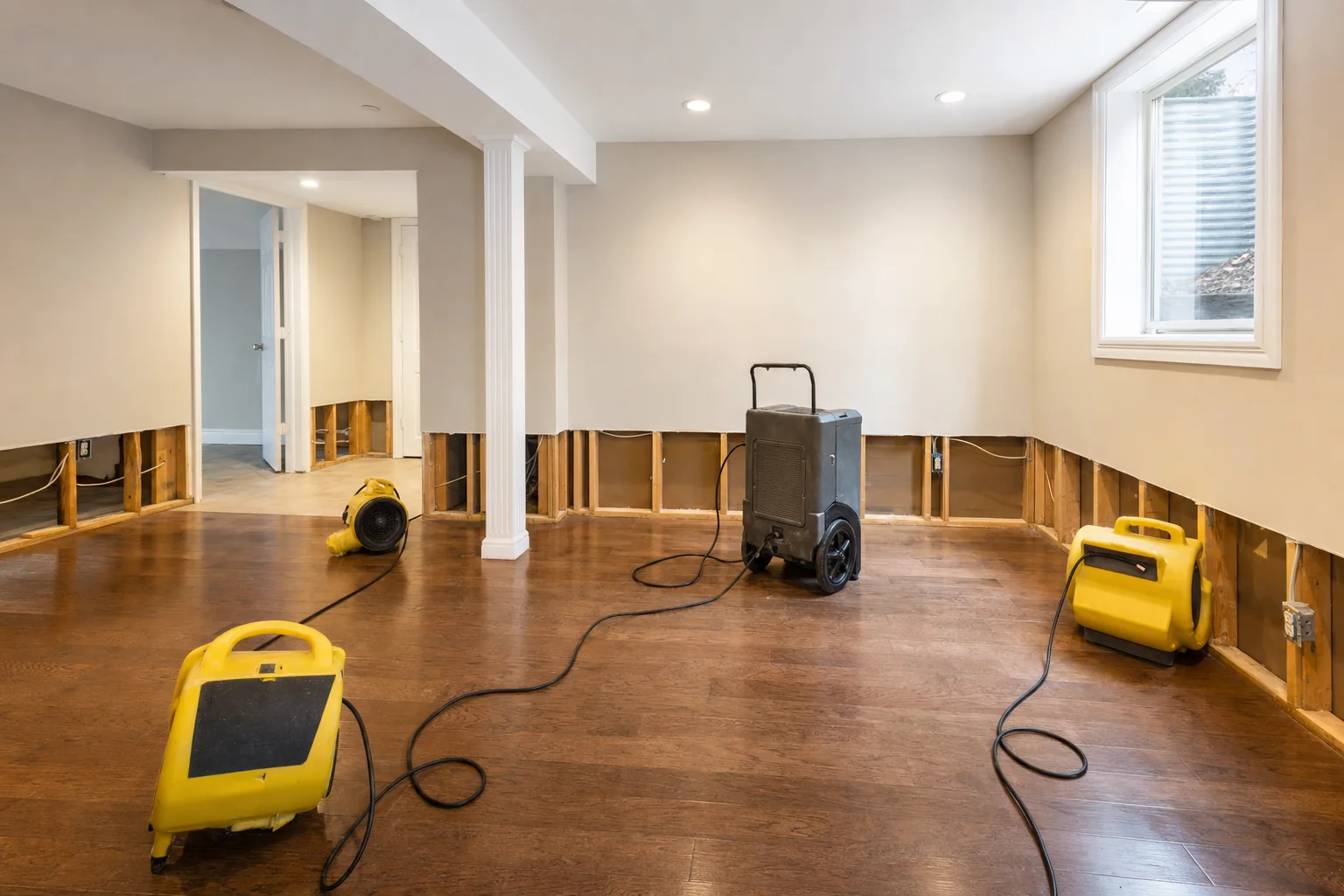
- Structural drying. Commercial dehumidifiers and air movers bring wood moisture content and space humidity back to safe levels, typically over three to five days.
- Moisture control and prevention. A new sealed vapor barrier, drainage corrections, and often a dedicated dehumidifier are installed so the problem does not recur.
- Post-remediation verification. Final moisture and visual checks confirm the space is dry and clean before closeout.
Note what comes first and last: moisture. You cannot remediate your way out of a crawl space mold problem if the water keeps coming, which is why a reputable contractor treats the moisture source as central to the job, not an afterthought.
Smell something musty or spot growth under your home? Do not wait for it to spread into your floors and living space. Call AZA Restoration at (571) 506-6668 for 24/7 emergency response, guaranteed 90-minute on-site arrival across Northern Virginia, and direct insurance billing. One call rebuilds it all.
Encapsulation versus venting: which crawl space strategy wins?
Once a crawl space is cleaned and dried, what keeps mold away is how you manage moisture long term. The two broad approaches are traditional venting and modern encapsulation. For most Northern Virginia homes, encapsulation is the more durable solution despite a higher upfront cost. Here is how they compare.
| Factor | Vented crawl space (traditional) | Encapsulated crawl space (sealed) |
|---|---|---|
| How it manages moisture | Relies on outdoor air flowing through vents | Sealed liner plus dehumidifier controls humidity |
| Performance in humid NoVA summers | Poor; humid air can add moisture | Strong; humidity held below mold threshold |
| Effect on mold risk | Higher ongoing risk | Substantially reduced risk |
| Effect on energy bills | Can raise heating and cooling costs | Often lowers them by stabilizing floor temps |
| Typical upfront cost | Lower | Higher, but better long-term value |
Encapsulation seals the crawl space floor and walls with a heavy-duty vapor barrier, closes the foundation vents, seals rim joists, and adds a dedicated dehumidifier to hold humidity in the safe zone. The result is a clean, dry, conditioned space that resists mold, improves the air your family breathes, and frequently reduces energy bills because your subfloor is no longer fighting outdoor conditions.
Repair versus replace: salvaging crawl space materials
A common homeowner question is whether moldy materials can be cleaned or must be torn out. The answer depends on the material and how deeply mold has penetrated.
- Framing and subfloor (wood): Usually repairable. Solid structural wood can typically be cleaned, treated, and encapsulated. Replacement is reserved for wood that has rotted or lost structural integrity.
- Fiberglass and paper-faced insulation: Usually replace. Porous, moldy insulation is rarely worth saving and is removed and replaced.
- Old vapor barrier: Always replace. A torn or contaminated barrier is removed and a new sealed one installed.
- Stored cardboard, fabric, and porous items: Usually discard. These hold spores and should not be stored in a crawl space going forward.
How much does crawl space mold remediation cost in Northern Virginia?
Crawl space mold remediation in Northern Virginia typically ranges from $500 to $6,000, driven by the size of the affected area, how far the mold has penetrated, whether materials need replacement, and what moisture-control work is required to prevent recurrence. Small surface jobs sit at the low end; widespread or hidden colonization that involves structural drying and full encapsulation can exceed $10,000. The table below frames typical market ranges for related restoration work.
| Scope of work | Typical market range | Typical timeline |
|---|---|---|
| Mold remediation (most crawl space jobs) | $500 - $6,000 | 1 - 5 days |
| Widespread or hidden mold colonization | $10,000+ | Several days |
| Localized water damage (if a leak is involved) | $1,200 - $5,500 | 3 - 5 days drying |
| Crawl space flooding cleanup | $3,000 - $15,000+ | 5 - 10 days |
| Structural reconstruction (rotted framing) | $10,000+ per affected area | Weeks |
These are general market ranges, not quotes. Every crawl space is different, and the only way to get an accurate number is an on-site assessment. What inflates a project is almost always a moisture problem left unaddressed long enough to rot framing or require full encapsulation, so catching it early keeps you at the affordable end of the range.
Does homeowners insurance cover crawl space mold?
It depends on the cause. As a general rule, mold is covered when it results from a sudden, accidental, covered event such as a burst pipe, and excluded when it results from long-term neglect, gradual seepage, or deferred maintenance. Because the cause matters so much, documentation is critical. AZA Restoration offers direct insurance billing, meaning we document the loss, communicate with your adjuster, and bill the carrier directly where coverage applies, so you are not floating large out-of-pocket costs.
Do you need a permit for crawl space mold work in Northern Virginia?
For most crawl space mold remediation, the answer is no. Cleaning mold, replacing insulation, installing a new vapor barrier, and like-for-like drying or surface repairs are generally exempt from permitting. A permit becomes necessary when the work crosses into structural, electrical, or plumbing territory, such as replacing rotted floor joists or sistering structural members, rewiring, or repiping. That kind of work is regulated under the Virginia Uniform Statewide Building Code (USBC) and requires a permit from your local building office.
Each jurisdiction issues and inspects these permits through its own office. In Fairfax County, that is Land Development Services; Loudoun, Prince William, Stafford, Fauquier, and Arlington counties, along with the cities of Alexandria, Falls Church, Manassas, and Manassas Park, each operate their own building departments. As a Class A licensed restoration and general contractor, AZA Restoration pulls the required permits and builds to code, so you do not have to navigate the county process or worry about an unpermitted repair surfacing during a future home sale.
Why working with a licensed contractor matters
Mold remediation is not regulated as tightly as plumbing or electrical work, so anyone with a shop vac and a bottle of bleach can call themselves a remediator. Improper work spreads spores through your home, misses the moisture source, or masks a structural problem. A Class A licensed and fully insured contractor carries the credentials to handle both the remediation and any reconstruction, follows industry restoration standards, and stands behind the work. Bleach, incidentally, is the wrong tool for porous wood; it does not penetrate and leaves the root structure of the mold intact.
How can you prevent crawl space mold from coming back?
Prevention is far cheaper than remediation, and most of it comes down to keeping water out and humidity down. Here is a practical, prioritized checklist for Northern Virginia homeowners.
- Install and seal a quality vapor barrier. A continuous, sealed barrier across the soil floor and up the foundation walls is the single most effective moisture-control measure.
- Fix exterior drainage. Grade soil to slope away from the foundation, clean gutters, and extend downspouts at least several feet from the house.
- Control humidity. A crawl space dehumidifier or a sealed, encapsulated system keeps relative humidity below the roughly 60 percent threshold where mold thrives.
- Repair leaks promptly. Inspect plumbing and HVAC lines in the crawl space periodically and fix drips and condensation immediately.
- Consider encapsulation. In our climate, a sealed and conditioned crawl space is the most reliable long-term defense against recurring moisture and mold.
- Inspect seasonally. Check the crawl space each spring and fall, and after any major storm, for standing water, condensation, and new growth.
- Keep porous items out. Do not store cardboard boxes, fabric, or paper goods in the crawl space; they hold moisture and feed mold.
None of these steps is exotic, but together they break the moisture cycle that drives nearly every crawl space mold problem we see. If your home has a history of crawl space dampness, a one-time investment in proper moisture control pays for itself many times over in avoided remediation and structural repair.
When should you call a professional?
Small, isolated surface mold caught early can sometimes be handled by a careful homeowner with proper protective equipment. But you should call a licensed restoration contractor when any of the following is true: the affected area exceeds roughly ten square feet, mold has penetrated the wood or spread across multiple joists, there is standing water or a flooding event, you smell a strong musty odor on your first floor, anyone in the home has unexplained respiratory symptoms, or you simply are not sure how far the problem has spread. Crawl spaces are tight, dirty, and easy to misjudge from a quick glance, and a professional assessment removes the guesswork.
Serving Fairfax, Loudoun, Prince William, Stafford, Fauquier, and Arlington counties plus Alexandria, Falls Church, Herndon, Manassas, and Manassas Park, AZA Restoration brings trained restoration specialists, proper containment, and full reconstruction capability under one roof. The same team that diagnoses the problem can clean it, dry it, and rebuild whatever needs rebuilding.
Ready to get your crawl space dry, clean, and protected for good? Call AZA Restoration today at (571) 506-6668. We offer 24/7 emergency response, a guaranteed 90-minute on-site arrival anywhere in Northern Virginia, direct insurance billing, and Class A licensed remediation and reconstruction. One call rebuilds it all.
Frequently Asked Questions
Is crawl space mold dangerous to my health?
Crawl space mold can affect people in the home above it because of the stack effect, which continuously pulls air, moisture, and spores up into your living areas. Exposure commonly aggravates allergies, asthma, and other respiratory conditions, with greater effects for children, older adults, and anyone with a compromised immune system. No level of indoor mold growth is considered desirable, and persistent symptoms that ease when you leave the house are a strong signal to have the crawl space inspected.
How long does it take for mold to grow in a crawl space?
Under the warm, damp conditions typical of a Northern Virginia crawl space, mold can begin colonizing surfaces within 24 to 48 hours of a moisture event and become visibly established within a week or two. Because spores are always present in the air and the wood and insulation provide a ready food source, the only limiting factor is moisture. This is why drying a wet crawl space quickly and keeping humidity below roughly 60 percent are so important to preventing growth.
Can I remove crawl space mold myself, or should I hire a professional?
A small surface bloom under about ten square feet, caught early, can sometimes be cleaned by a homeowner using proper protective equipment and a HEPA vacuum, though bleach is not recommended on wood because it does not penetrate porous surfaces. Hire a licensed professional when the area is larger, when mold has penetrated the wood or spread across multiple joists, when there is standing water, or when the moisture source is unclear. A professional uses containment and air filtration to avoid spreading spores and addresses the underlying moisture so the problem does not return.
Does encapsulation really stop crawl space mold?
Encapsulation is the most reliable long-term defense against crawl space mold in our humid climate because it removes mold's only controllable requirement: moisture. By sealing the soil floor and walls with a heavy-duty vapor barrier, closing foundation vents, and adding a dedicated dehumidifier, encapsulation holds relative humidity below the level at which mold can grow. It also tends to improve indoor air quality and lower energy bills. It is not a substitute for fixing active leaks or drainage problems, but combined with those repairs it dramatically reduces the chance of mold returning.
How much does crawl space mold remediation cost in Northern Virginia?
Most crawl space mold remediation in Northern Virginia falls between $500 and $6,000, depending on the size of the affected area, how deeply the mold has penetrated, whether materials such as insulation need replacing, and what moisture-control work is required to prevent recurrence. Widespread or hidden colonization that involves structural drying and full encapsulation can exceed $10,000. The most reliable way to get an accurate figure is an on-site assessment, and catching the problem early keeps you at the lower end of the range.