To choose a restoration company in Northern Virginia, ask ten questions before you sign anything: Is the contractor Class A licensed and fully insured? Can they guarantee a fast emergency arrival? Will they bill your insurer directly? Do they handle both the cleanup and the rebuild? Can they pull permits under the Virginia building code, and prove past results in your county? The single best filter: the right restoration contractor answers the phone 24/7, arrives within roughly 90 minutes, carries Class A licensing plus general liability insurance, and takes your home from emergency mitigation through final reconstruction without handing you off to a separate builder. Everything below explains why each question matters and what a strong answer sounds like.
Water, fire, mold, and storm damage force fast decisions, often while you are stressed, displaced, or staring at a flooded basement at 2 a.m. That pressure is exactly when homeowners hire the wrong company. The questions below slow the decision down just enough to protect your property, your insurance claim, and your wallet.
Why choosing the right restoration contractor matters so much
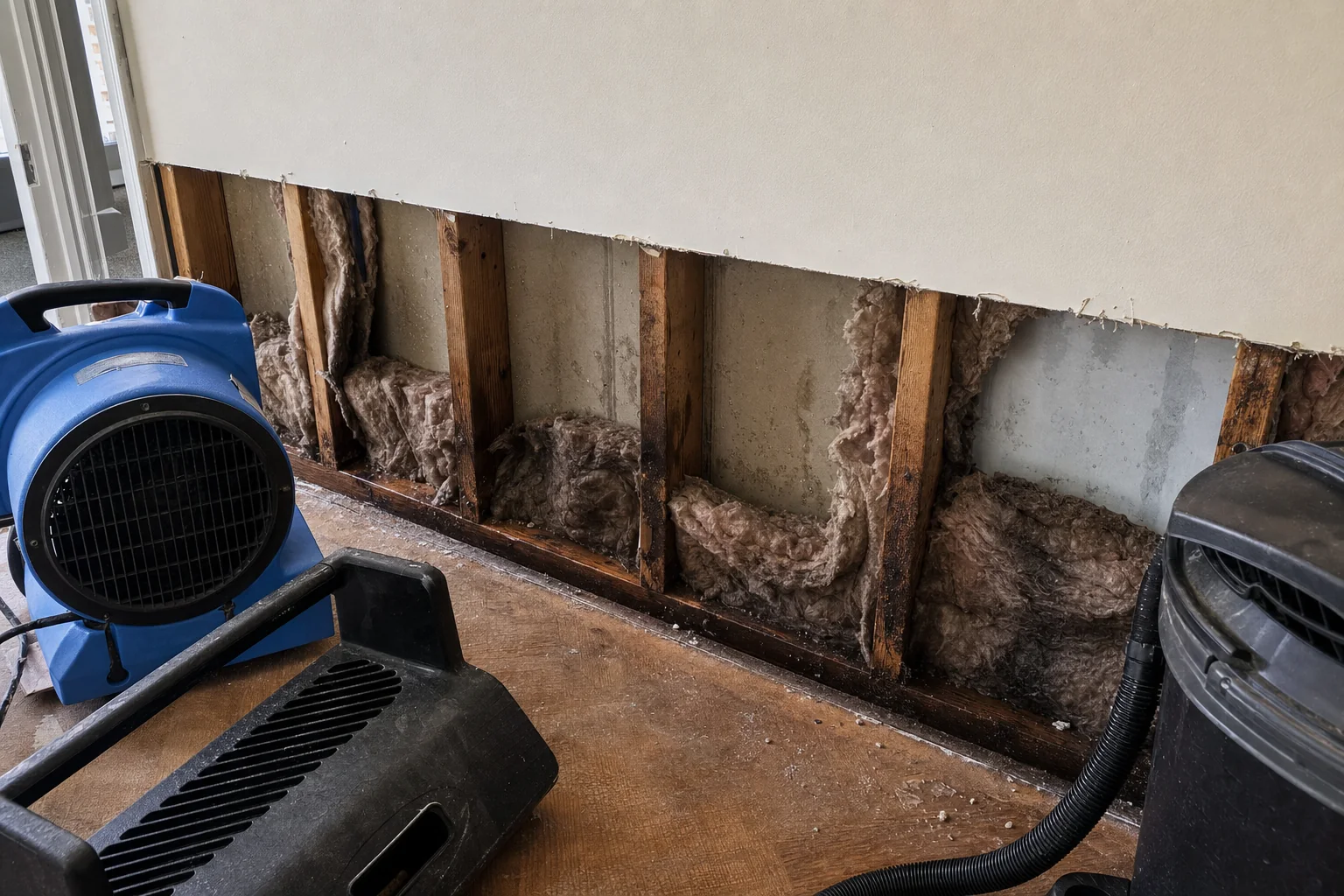
Restoration is unlike most home services because the clock is part of the job. Water migrates into drywall, subfloor, and framing within hours. Mold can begin colonizing damp material in roughly 24 to 48 hours. Smoke residue turns acidic and etches metal, glass, and finishes the longer it sits. A contractor who is slow, undertrained, or under-equipped does not just do mediocre work; they let secondary damage compound while the meter runs.
The financial stakes are real. A localized water loss handled correctly on day one might cost $1,200 to $5,500 to mitigate. The same loss, left to spread or dried improperly, can balloon into an $8,000 to $25,000 whole-home event with mold layered on top. Choosing well is not about finding the cheapest crew; it is about finding the team that keeps a small loss from becoming a large one while documenting the claim your adjuster has to approve.
Northern Virginia adds its own wrinkles. Our housing stock ranges from 1950s slab ranches in Falls Church to new construction in Loudoun and Prince William, each behaving differently when wet. Our summers are humid, our soils hold water, and our watersheds, from the Potomac tributaries to Bull Run and the Occoquan, mean heavy storms regularly push water where it does not belong. A contractor who understands this region's climate and the Virginia Uniform Statewide Building Code (USBC) will serve you better than a national franchise reading from a generic script.
Question 1: Are you Class A licensed and fully insured?
This is the non-negotiable first filter, and it is two questions in one. In Virginia, a Class A contractor license is the top tier, allowing work with no dollar limit on project size, which matters when a fire or flood becomes a full reconstruction. Anyone rebuilding your home's structure should hold Class A licensing. Ask for the license number and verify it through the Virginia Department of Professional and Occupational Regulation (DPOR).
"Fully insured" means the contractor carries general liability insurance and workers' compensation. If an uninsured worker is injured in your home, or an uninsured crew damages a neighbor's property, the liability can land on you. Ask to see a certificate of insurance, not just a verbal assurance. AZA Restoration is Class A licensed, fully insured, and operates as both a restoration specialist and a general contractor, which is what lets one team handle mitigation and rebuild end to end.
What a weak answer sounds like
Be wary of vague responses like "we're totally licensed, don't worry about it" with no number offered, or a contractor who carries only a lower-tier license but proposes major structural work. Reputable trained restoration specialists volunteer their credentials without being pushed.
Question 2: How fast can you actually be on site?
In an active water or sewage emergency, response time is damage control. Every hour standing water sits, it wicks higher into walls and deeper into flooring. Ask for a specific, guaranteed arrival window, not a vague "we'll get someone out soon." A serious emergency-response company keeps 24/7 dispatch and staged equipment so crews mobilize immediately.
AZA Restoration answers 24/7 with a guaranteed 90-minute on-site response across Fairfax, Loudoun, Prince William, Stafford, Fauquier, and Arlington counties — plus Alexandria, Falls Church, Herndon, Manassas, and Manassas Park. We bill your insurance directly.
Call (571) 506-6668AZA Restoration guarantees a 90-minute on-site arrival across Northern Virginia, with around-the-clock emergency response every day of the year. That speed comes from local positioning. A company headquartered far away, or one that subcontracts your call to whoever is free, cannot make that promise. Weigh the geography: is this crew actually based near your county, or routing through a call center?
| Disaster type | Why response time matters | Window of risk |
|---|---|---|
| Water damage | Water wicks into drywall, subfloor, and framing | Secondary damage within hours |
| Mold growth | Spores colonize damp organic material | Begins in roughly 24-48 hours |
| Sewage / | Pathogens spread; Category 3 contamination | Hazard escalates by the hour |
| Fire / smoke | Acidic soot etches metal, glass, and finishes | Corrosion worsens over days |
| Storm / wind | Open envelope lets rain into the structure | Tarp/board-up needed same day |
Question 3: Do you handle both mitigation and reconstruction?
This question saves homeowners more headaches than any other. Many restoration outfits only do the first half: they extract water, dry the structure, and tear out damaged materials, then hand you a referral to "a builder we work with." Now you are managing two companies, two contracts, and two finger-pointing parties when something goes wrong.
A full-service contractor handles the entire arc: emergency mitigation, structural drying, demolition, and full reconstruction back to pre-loss condition, including drywall, flooring, paint, cabinetry, and trim. AZA Restoration is built around exactly this model; the slogan "One call rebuilds it all" reflects a single accountable team from the first water reading to the final coat of paint. When comparing companies, ask directly: "Will you also rebuild, or do I need a separate general contractor?" Reconstruction ranges from roughly $10,000 for a single room to $100,000-plus for a major rebuild, so having one licensed entity own the whole scope protects both your timeline and your warranty.
Repair vs. replace: who decides?
A trustworthy contractor walks you through the repair-versus-replace logic transparently. Hardwood dried within the window can often be refinished rather than replaced. Soaked carpet pad and drywall below the flood line almost always come out. Swollen engineered flooring and particleboard cabinetry rarely recover. A company that proposes replacing everything regardless of condition, or tries to "save" clearly ruined materials to cut its own labor, is not acting in your interest. Insist on moisture-meter readings and photos that justify each call.
Dealing with active damage right now? Don't let secondary damage compound while you compare bids. Call AZA Restoration at (571) 506-6668 for 24/7 emergency response, a guaranteed 90-minute on-site arrival across Northern Virginia, and direct insurance billing. One call rebuilds it all.
Question 4: Will you bill my insurance company directly?
Direct insurance billing is one of the clearest signals of an experienced restoration company. It means the contractor works with your insurer's adjuster, submits documentation in the format carriers expect, and bills the insurer directly so you are typically only responsible for your deductible rather than fronting the entire loss.
Ask how they handle the claim. Strong answers include photographing all damage on arrival, recording moisture and humidity readings, writing line-item estimates in industry-standard software, and communicating directly with your adjuster. AZA Restoration offers direct insurance billing and coordinates with carriers on every covered loss. A poorly documented claim gets denied or underpaid, leaving you to argue with your insurer alone, so a contractor who knows the documentation game protects the money your premiums have been buying.
A word of caution on "we'll waive your deductible"
If a contractor offers to "eat" or waive your insurance deductible, treat it as a red flag. In Virginia, that practice can constitute insurance fraud, and a company willing to commit it on your behalf is telling you something about its ethics. Your deductible is your contractual share of the loss; a legitimate company will not pretend otherwise.
Question 5: Can you show local results in my county?
Restoration is a local trade. A company that has worked across Fairfax, Loudoun, Prince William, Stafford, Fauquier, and Arlington counties, plus Alexandria, Falls Church, Herndon, Manassas, and Manassas Park, understands the failure patterns of our housing stock and climate. They know how a finished basement in a Burke split-level floods differently than a townhouse in Ashburn, and which county building offices to call for permits.
Ask to see proof. Reputable contractors maintain documented case studies and a body of verified customer reviews. Look for specifics: the type of loss, the scope, the timeline, the outcome. Generic five-star ratings are easy to fake; documented before-and-after narratives in your area are not. Local results also tell you the company is established here and will still be around to honor its warranty next year.
Question 6: How do you handle mold safely?
Mold deserves its own question because it is where corners get cut most often. After any water loss, mold is a real risk within 24 to 48 hours, and improper handling spreads spores through the home. A qualified contractor follows industry restoration standards for containment: sealing the affected area with plastic barriers, running negative-air HEPA filtration, removing contaminated porous materials, treating surfaces, and verifying dryness before closing anything up.
Mold remediation typically costs $500 to $6,000, though widespread or hidden growth behind walls can exceed $10,000, and most jobs take one to five days. Ask how the contractor confirms the area is actually dry and clean before rebuilding, because sealing wet framing behind new drywall is how a $2,000 problem becomes a $15,000 one a year later. AZA Restoration's mold remediation approach pairs containment with structural drying so the moisture source is resolved, not buried.
Beware "mold testing" sales tactics
Be cautious of any company that pushes expensive mold testing on every job or uses an alarming inspection to upsell. Visible mold after a known water loss generally needs remediation, not a costly lab report to confirm the obvious. Independent testing has its place, especially for verification after a large job, but it should not be a fear-based sales funnel.
Question 7: Do you understand Virginia permits and code?
This question separates true general contractors from cleanup-only crews. In Virginia, the type of work determines whether a permit is required. Like-for-like drying and surface repairs, such as replacing drywall and repainting, are usually exempt. But structural, electrical, and plumbing rebuilds require a permit under the Virginia Uniform Statewide Building Code (USBC), issued by the relevant county or city building office, such as Fairfax County Land Development Services or its equivalent in Loudoun, Prince William, or Arlington.
A contractor who shrugs at permits, or proposes major structural work "off the books," is exposing you to real risk. Unpermitted structural work can fail inspection, void your insurance, and surface as a problem when you sell. AZA Restoration pulls the required permits and builds to code as a standard part of full reconstruction. Ask: "For this scope, what permits are required, and who pulls them?" The right answer is specific, names the local jurisdiction, and makes clear the contractor handles the paperwork.
| Type of work | Permit usually required? | Authority |
|---|---|---|
| Structural drying, dehumidification | No (mitigation) | N/A |
| Drywall replacement, repaint (like-for-like) | Generally no | N/A |
| Structural framing repair / rebuild | Yes | County/city building office (USBC) |
| Electrical rewiring | Yes | County/city building office (USBC) |
| Plumbing reconfiguration | Yes | County/city building office (USBC) |
Question 8: What does your written estimate include?
Never hire a restoration contractor on a verbal number or a one-line total. A professional estimate is itemized, breaking out mitigation, equipment, materials, labor, and reconstruction as separate line items in the same format your adjuster uses. This lets you compare bids on equal terms and gives your insurer a document they can approve quickly.
Use the market ranges below to sanity-check any estimate. If a bid comes in far under these ranges, ask what is being left out; if far over, ask what is driving it. Both extremes deserve an explanation.
- Water damage: localized $1,200-$5,500; major or whole-home $8,000-$25,000+. Structural drying typically 3-5 days.
- Flood: $3,000-$15,000+, higher for Category 3 (contaminated) water. Cleanup and dry-out 5-10 days.
- Mold remediation: $500-$6,000; widespread or hidden growth can exceed $10,000. Usually 1-5 days.
- Fire: soot and smoke cleanup from about $3,000; full reconstruction up to $50,000+. Cleanup takes days, rebuild takes weeks.
- Smoke and odor removal: $2,000-$15,000.
- Storm and wind: emergency tarp or board-up $300-$1,500; full repairs $2,500-$20,000+.
- sewage: $1,500-$10,000+.
- Reconstruction: roughly $10,000 for a single room to $100,000+ for a major rebuild.
These are typical market ranges, not quotes; your actual cost depends on the size of the loss, the materials involved, and the category of water or contamination. A reputable contractor will explain where your specific project lands and why.
Question 9: Who is actually doing the work?
Find out whether the company uses its own trained crews or subcontracts the work, and whether the people who show up are employees or day labor assembled per job. This is about accountability and quality control. In-house crews follow the company's standards, carry its insurance, and answer to one chain of command; heavily subcontracted work introduces gaps where no one quite owns the outcome.
Ask who your point of contact will be from start to finish. The strongest answer is a single project manager who owns your job through mitigation and reconstruction, not a relay of strangers. Because AZA Restoration operates as both restoration specialist and general contractor with its own trained restoration specialists, the same accountable team carries your project from the first emergency call through the final walkthrough.
Communication is a quality signal
Watch how the company communicates during the estimate phase. Do they return calls promptly, explain the process in plain language, and set realistic timelines instead of telling you whatever you want to hear? How a contractor treats you before the contract is signed is the best preview of how they will treat you mid-project, when something inevitably needs adjusting.
Question 10: What guarantees and warranties do you stand behind?
Finally, ask what happens after the work is done. A confident contractor backs its reconstruction with a workmanship warranty and stands behind the dryness and cleanliness of its mitigation. Get the terms in writing, and find out how long the company has operated in Northern Virginia, because a warranty is only as good as the company still being in business to honor it.
Also confirm the contractor verifies its own work objectively. For drying, that means documenting that materials have returned to normal moisture content before reconstruction begins, not just "it looks dry." For mold jobs, it means confirming the area is clean before closing walls. This verification step protects you from a problem reappearing months later behind freshly painted drywall.
A simple step-by-step for vetting a restoration company
When disaster hits, run this sequence to make a fast but sound decision:
- Stop further damage first. Shut off water at the source if safe and call for emergency response; mitigation cannot wait for a perfect contractor search.
- Verify license and insurance. Confirm Class A licensing through DPOR and request a certificate of insurance.
- Confirm response time and local presence. A guaranteed arrival window and a real Northern Virginia base beat a distant call center.
- Ask if they do mitigation and reconstruction. One accountable team is simpler and safer than juggling two contractors.
- Check insurance billing. Direct billing and adjuster-ready documentation protect your claim.
- Review proof. Look at documented project case studies and verified reviews in your county.
- Get an itemized written estimate and compare it against the market ranges above.
- Confirm permits and warranty. Make sure the contractor pulls required USBC permits and backs the work in writing.
Work through those eight steps and you will filter out the storm-chasers, the cleanup-only crews who leave you stranded at the rebuild, and the uninsured operators who put your liability at risk. What remains is a contractor you can trust with your home.
Red flags to walk away from
Some signals should end the conversation regardless of price. Walk away from any contractor who cannot provide a license number and proof of insurance, demands large cash payments up front, refuses to put the scope in writing, offers to waive your deductible, pressures you to sign immediately "before the price goes up," or shows up unsolicited after a storm with out-of-state plates and no local address. After major weather events, Northern Virginia sees an influx of transient operators who collect deposits and disappear. A permanent local company with a verifiable Chantilly address, a documented track record, and Class A licensing is the antidote to that risk.
Frequently Asked Questions
How do I choose a restoration company in Northern Virginia?
Choose a restoration company by confirming it is Class A licensed and fully insured, guarantees a fast emergency arrival, bills your insurance directly, and handles both mitigation and full reconstruction in-house. Ask for the license number, a certificate of insurance, an itemized written estimate, and documented local results in your county. The strongest contractors operate 24/7, are based in Northern Virginia, pull required Virginia building permits, and back their work with a written warranty. AZA Restoration meets all of these criteria and can be reached at (571) 506-6668.
Should restoration and reconstruction be done by the same company?
Yes. A single Class A licensed contractor handling both mitigation and reconstruction owns the entire process from water extraction and drying through demolition and full rebuild, which means one contract, one schedule, one warranty, and no finger-pointing between separate companies. Cleanup-only crews that hand you off to a separate builder leave you to coordinate two parties and absorb the gaps between them. AZA Restoration is built around this all-in-one model, summed up in the slogan "One call rebuilds it all."
How fast should a restoration contractor respond to an emergency?
A restoration contractor should respond to an active emergency within roughly 90 minutes, because water spreads into drywall and framing within hours and mold can begin growing in 24 to 48 hours. Any delay lets secondary damage compound and raises the total cost. Look for a company with genuine 24/7 dispatch and a local Northern Virginia base rather than a call center that routes your job elsewhere. AZA Restoration guarantees a 90-minute on-site arrival across the region, day or night.
Do I need a permit to repair water or fire damage in Virginia?
It depends on the work. Like-for-like drying and surface repairs, such as replacing drywall and repainting, are usually exempt. Structural, electrical, and plumbing rebuilds require a permit under the Virginia Uniform Statewide Building Code (USBC), issued by your county or city building office, such as Fairfax County Land Development Services. A qualified general contractor pulls the required permits and builds to code; a cleanup-only crew often cannot. AZA Restoration handles permitting as a standard part of reconstruction.
Will the restoration company bill my insurance directly?
A reputable restoration company will bill your insurance carrier directly, coordinating with your adjuster and submitting documented, itemized estimates so you typically pay only your deductible rather than the full cost up front. Strong documentation, including photos and moisture readings, also helps prevent your claim from being denied or underpaid. Be cautious of any contractor who offers to waive your deductible, as that practice can constitute insurance fraud in Virginia. AZA Restoration offers direct insurance billing on covered losses.
How much does damage restoration cost in Northern Virginia?
Costs vary by type and severity. As typical market ranges: localized water damage runs about $1,200 to $5,500 and major or whole-home losses $8,000 to $25,000+; flood cleanup $3,000 to $15,000+; mold remediation $500 to $6,000; fire and smoke cleanup from around $3,000 with full reconstruction reaching $50,000+; and full rebuilds from about $10,000 for one room to $100,000+ for major work. These are ranges, not quotes; an itemized written estimate from a licensed contractor will reflect your specific situation.
Ready to choose a restoration contractor you can trust? AZA Restoration is Class A licensed, fully insured, and serves all of Northern Virginia with 24/7 emergency response, a guaranteed 90-minute on-site arrival, and direct insurance billing, from the first water reading through full reconstruction. Call (571) 506-6668 now. One call rebuilds it all.